Genetics and the Prehistory of Dravidian Languages
Dedicated to David McAlpin (1945-2023)
Abstract
Recent genetic studies, which are perhaps not yet familiar to linguists, have cast a new light on the origins of the Dravidian language family of India, so this review paper compares Dravidian historical linguistics and archaeology with recent archaeogenetics publications and concludes that they support the Proto-Elamo-Dravidian (Proto-Zagrosian) model of McAlpin and Southworth.
Keywords: Genetics, Elamo-Dravidian, Zagrosian, Tamil, India, Indus Valley, Aryans, Iran, Elamite.
1. Introduction
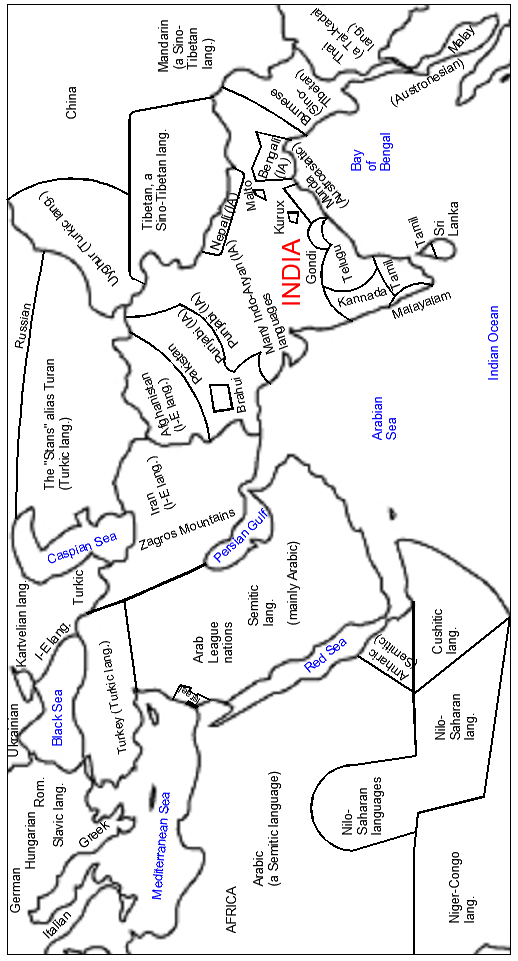
Dravidian is the world’s sixth largest family of languages, comprising over 24 languages (Steever, 2017) that are spoken by 250 million people living mainly in South Asia. See Figure 1, which shows the linguistic map of India and a few other countries. In southern India, the 4 major Dravidian languages, i.e., Telugu, Tamil, Kannada and Malayalam, have a total of 240 million speakers, a number that has just started to decrease due to low birth rates, a first in overpopulated India. About 20% (Misra, 2024) of India’s people speak the Dravidian languages whose speakers have included Nobel laureates and world chess champions. Nearly all the rest of India’s population, who live mainly in North India, speak various Sanskrit-derived Indo-Aryan (IA) languages, e.g., Hindi, Punjabi, Gujarati, Marathi, Bengali, etc., which are a subset of the larger Indo-European family (Cardona, 2025). The two other language families found in India are Tibeto-Burman and Austro-Asiatic (e.g., Munda), but they are spoken only by small, remote tribal populations (Southworth, 2005: 51–52).
A total of 9 million Tamils live in northern Sri Lanka and Malaysia. North Dravidian languages such as Kurukh (Kurux) and Malto are spoken by small populations of tribal peoples in eastern India and Bangladesh. Pakistan has over 2 million speakers of Brahui, which is regarded as a North Dravidian language by some linguists (Krishnamurti, 2003: 20–22). In recent decades, over 3 million Dravidian speakers, many of them educated professionals, have settled in the U.S., U.K., Canada and Australia.
1.1 A Very Brief History of Dravidian Linguistics and Literature
In 1816, Francis Whyte Ellis, a British official working in India, was the first to write that southern India’s languages form a distinct family of languages which had no connection to Sanskrit except in the form of the many Sanskrit loanwords in them (Krishnamurti, 2003: 16–17).
Between 1856 and 1913, the various editions of Robert Caldwell’s Comparative Grammar of Dravidian convinced scholars that Ellis had been right. The modern era of Dravidian linguistics began in 1961 when Krishnamurti wrote his book on Telugu verbal bases. In the same year, Burrow and Emeneau published the Dravidian Etymological Dictionary (DED), which is still a standard reference work, especially its 2nd edition in 1984. Proto-Peninsular Dravidian reconstructions are given in Krishnamurti (2003: 523) and the Starling Database. The books and/or papers, listed in the references section of this paper, of Krishnamurti, Subrahmanyam, Zvelebil, McAlpin, Parpola, Steever, Andronov and Southworth form the literature of Dravidian linguistics. The Dravidian Linguistics Association of India sells useful papers and books. See also this paper’s additional references section written by an anonymous referee.
Only 4 Dravidian languages are literary languages. The literatures of Kannada, Telugu and Malayalam began in medieval times, but Tamil literature and inscriptions date back to the 3rd century BCE (Steever, 1998). The claim that the potsherds bearing Tamil graffiti found in Keezhadi (also spelled Keeladi) are from the 6th century BCE is not accepted by non-Tamil archaeologists (Charuchandra, 2019). The earliest extant books in Tamil, called the Sangam poems, were written by bards who supposedly were members of the third Sangam (meaning academy, from the Sanskrit sangha). Claims by some Tamilians about the ‘lost’ poems from the ’first’ and ‘second’ Sangams, supposedly founded around 10000 BCE and 5500 BCE (Sastri, 1897), which got submerged by rising sea-levels along with the geologically impossible vast Kumari Kandam continent, are not credible (Ramaswamy, 2004 and Zvelebil, 1992).
Recent genetics papers, for instance, Narasimhan et al. (2019), suggest the possibility that Ancient Ancestral South Indians (AASI) may have been speaking Proto-Dravidian (PD) as their mother tongue, so the next section of this paper, which is on archaeogenetics, examines this possibility.
2. Archaeogenetics and the Prehistory of India
2.1 The Recent African Origin of Humans
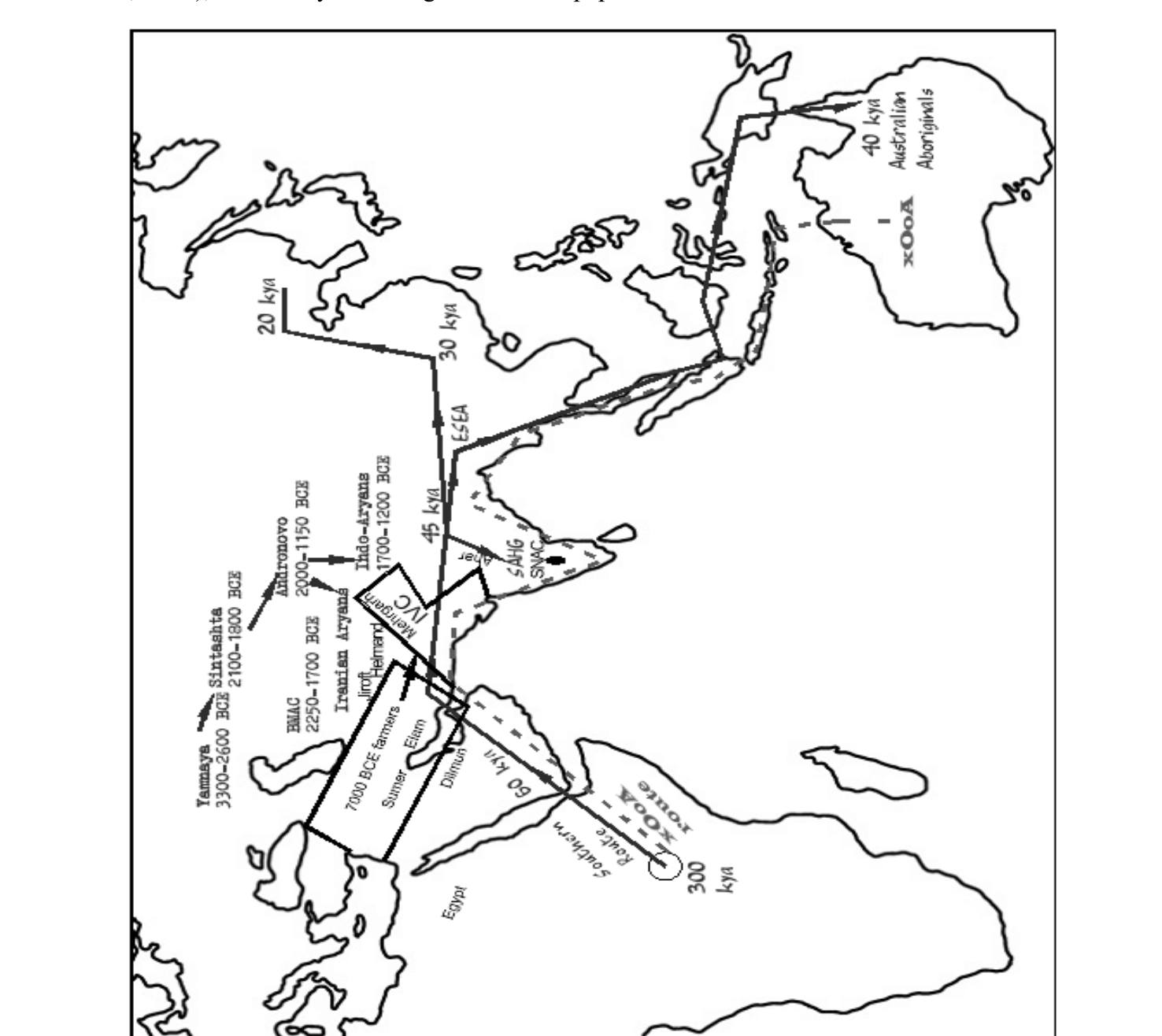
It is now well-accepted by paleontologists that the human species, Homo sapiens, originated in East Africa 300 kya (kiloyears ago) and started spreading across the world 60 kya to 50 kya (Handwerk, 2021). See Figure 2, which shows only a few migration routes (continuous lines with arrows) from 300 kya to 40 kya and a few other relevant migration routes (short segments with arrows) from 10 kya to 4 kya. The xOoA migration from Africa to Australia, shown as a dashed line in Figure 2, took place much earlier than the southern migration route, which is shown—as previously mentioned—by continuous lines with arrows. The genome from the xOoA migration is now found only in Australia and Papua New Guinea; No trace of it or earlier human or hominin migrations to India is seen genetically in South Asians today (Culotta, 2016). So, it is highly unlikely that these earlier migrations contributed anything to later human speech in India or elsewhere (Culotta, 2016), hence they will be ignored in this paper.
2.2 South Asian Hunter-Gatherers (SAHG), the ancestors of the AASI
As Figure 2 shows, humans crossed into Arabia 60 kya. Some of them reached the present India-Nepal border 45 kya, i.e., close to the start of the Upper Paleolithic Age. There, this population trifurcated into South Asian Hunter-Gatherers (SAHG, who later became the AASI), East and Southeast Asians (ESEA) and Australasians (AA), according to Yang (2022), but other references (e.g. Bennett et al., 2024) show the trifurcation happening in Pakistan or Burma. The SAHG entered India some 45 kya and slowly spread across much of that sub-continent, including its west coast, but South Asia’s archaeological record does not reveal much about the SAHG. Cave paintings, which began to appear along with the Mesolithic, i.e., 10,000 BCE (Clottes, 2004), may be associated with the SAHG, as can the Southern Neolithic Archaeological Complex (SNAC) of 2500 BCE onwards (Thapar, 2025), which is discussed later.
It is impossible to know what language the three aforesaid groups spoke 45,000 years ago. The only language choice that is available from a few brave linguists (Fleming et al., 2013) is a language superfamily called Borean, which was spoken 45 kya. Borean was proposed as the ancestor of many of today’s language families or proposed superfamilies, including Nostratic. Today, the descendants of the SAHG in South India, ESEA, and Australasians speak Dravidian, Austric, and Australian languages, all probable descendants of Borean. The Austric superfamily proposal combines several existing recognized language families of East and Southeast Asia and is not accepted by most linguists (van Driem, 2001). The Australian language superfamily combines Pama-Nyungan and non-Pama-Nyungan, so it includes all Aboriginal languages (Harvey and Mailhammer, 2024).
When, if at all, did the SAHG start speaking Dravidian languages? Since genetics has proven (Yang, 2022) that the SAHG, ESEA and AA diverged from each other, it is reasonable to suppose that Dravidian, Austric and Australian may be remotely related to one another, as discussed below.
2.2.1 Is there a Relationship between Australian and Dravidian?
At present, standard textbooks on historical linguistics state that 90% of the 250 remaining Aboriginal languages of Australia belong to the Pama-Nyungan language family. The remaining 10% belong to what is called the non-Pama-Nyungan family. Harvey and Mailhammer (2024) have combined the 2 language families and have reconstructed Proto-Australian.
Eminent Australianist Dixon (1980: 19) admits that there is no way of telling whether proto-Australian was spoken 30,000 years or longer ago, or more recently, such as 4000 years ago, but it seems clear that nearly all the languages of Australia form one genetic family going back to Proto-Australian (Dixon, 1980: 228). O’Grady and Hale (2004) write that there was a great extinction of languages in Australia 5 kya when the Pama-Nyungan languages replaced existing languages. This view is now widely accepted (Blazek, 2006), making it impossible to prove any remote connections between Dravidian and Australian. Harvey and Mailhammer (2024) conclude that Proto-Australian was most likely spoken 6000 years ago in the Northern Territory of Australia before spreading all over that continent. Bergstrom et al. (2016) point out that the overall evidence is consistent with a lack of gene flow from India to Australia in the Holocene, so connections between Pama-Nyungan and India’s languages are unlikely. Dixon (1980: 236–237) points out that a thorough search of Dravidian and Australian yields no systematic correspondences of form and meaning which could even hint at a genetic connection between the two. Thus, the conclusion is that any connection between Dravidian and Australian remains unproven.
2.2.2 Is there a Relationship between Austric languages and Dravidian?
The Austric superfamily of languages is a proposal, not accepted by most linguists, that combines several recognized language families of East and Southeast Asia, such as Austroasiatic, Austronesian, Tai-Kadai and Hmong-Mien into Greater Austric (van Driem, 2001). No systematic comparisons of these families with Dravidian seem to have been done by linguists. A comparison, using only wordlists, of Dravidian with Greater Austric or Sino-Tibetan reveals no cognates, though Caldwell (1913: 75) did find that Dravidian and Tibetan had somewhat similar personal pronouns. In eastern central India, some Dravidian languages have long been in contact with the Munda languages of the Austroasiatic family, but there is no genetic relationship (Krishnamurti, 2003: 26). Due to the above reasons, it is almost certain that there are no deep connections between Dravidian and any Austric language.
Thus, archaeology and linguistics are unable to prove that the Dravidian is related to Austric and/or Australian and/or that the SAHG/AASI of southern India spoke Dravidian languages. So, it is possible that in 10,000 BCE, the SAHG/AASI could have been speaking unknown languages which had no relationship to Australian or Austric. Both statements are consistent with the possible birth of Proto-Dravidian 1 (PDr1) somewhere between Iran and the Indus Valley Civilization (IVC) of Pakistan and north-west India, as discussed in the next section.
3. Genetics and the Elamo-Dravidian Hypothesis
In contemporary Iran, over 70% of the people speak one of several Indo-Iranian languages; nearly all the rest speak various Turkic languages. But in Bronze Age Iran which had only non-Aryan and non-Turkic people living in it, Stolper (2004) says that at its maximum extent, the Elamite linguistic area could have stretched from Azerbaijan in the Northwest to the eastern shore of the Persian Gulf and all the way east to Balochistan, i.e., at the western border of the IVC. This corresponds to the first quadrant of the rectangle in Figure 2, i.e., from the present Iran-Pakistan border to the shores of the Caspian Sea.
Bellwood (2013) points out that languages in pre-state societies usually spread through human migrations. Pathak et al. (2024) trace the creation of the L1-M22 Y-chromosome haplogroup 20.6 kya somewhere in the Middle East, its expansion there till 10 kya, and its arrival near the Indus River 8 kya. The authors, one of whom (Phillip Endicott) is a linguist, state that their study supports McAlpin’s Elamo-Dravidian language family proposal (which a few linguists actively oppose) by suggesting a connection between the roots of all Y-chromosomal L1-M22 lineages and the ancestry of Caucasus Iranian Hunter-Gatherers (CIHG or CHG). These were closely related to the Iranian farmers mentioned earlier, and the CIHG are the best candidate for disseminating both the Elamite and Dravidian languages to south-western Iran (Elam) and the IVC, respectively, with both these locations being the final areas of migration from yet another region inhabited by a population with CIHG ancestry. Their results do not support the suggestion that L1-M22’s geographical expansion started in Elam, but do not rule it out either.
McAlpin (2015) renamed Proto-Elamo-Dravidian as Proto-Zagrosian and Proto-Dravidian 2 as Proto-Peninsular Dravidian (PPD) and updated his original proposal (McAlpin 1981). McAlpin’s Zagrosian family tree is shown in Figure 3 below. His original term PDr1 is retained in it and in this paper. Note that authors other than McAlpin and Southworth refer to PPD as Proto-Dravidian (PD).
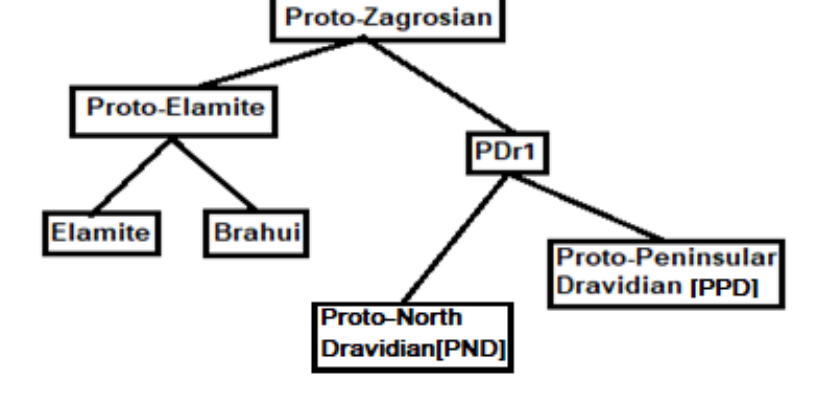
In Figure 3 above, PDr1 is McAlpin’s newly proposed proto-language that was intermediate between Proto-Zagrosian and PPD. McAlpin (2015) states his reasons for moving Brahui from the Dravidian language family, where most linguists place it, to the Elamite ‘family’. Genetic studies by Pagani et al. (2017) of the Brahui people have conclusively proven that they have no genetic affinity with South Indians and are no different from their Balochi neighbors. Brahui today has many Balochi loanwords. Pagani et al. (2017) conclude that the Brahui are a remnant of what was once a more widespread population of Brahui speakers. This strengthens the case for McAlpin’s Proto-Zagrosian model. Among Dravidianists, only Georgiy Starostin (2002) is skeptical about Elamo-Dravidian, but Zvelebil (1990: 113), Southworth (2011), Bomhard (1996) and Krishnamurti (van Driem, 2023) support it, though the latter initially had opposed it (Krishnamurti, 2003: 44–45). Blazek (1999) tried to link Elamite with Afroasiatic but does not view his theory as being opposed to McAlpin’s and sees no obstacle to bringing all three language families together (Starostin, 2002). Most non-Dravidianists consider Elamite to be a language-isolate (Stolper, 2004). Unlike Starostin, they do not actively oppose its membership in the Zagrosian family.
According to Pathak et al. (2024), the L1-M22 haplogroup could have arisen 20.6 kya anywhere within the tilted rectangular area shown in Figure 2, south-east of Turkey; then, this haplogroup reached the Indus River in 6000 BCE, having already spread all over the Middle East by 8000 BCE. Bomhard (1996: 111–112) states that Proto-Elamo-Dravidian (PED, i.e., McAlpin’s Proto-Zagrosian) came into being between 8000-7000 BCE, which seems to agree with the findings of Pathak et al. (2024). Pejros and Shnirelman (1988) said that PED’s homeland was the western or central Iran of today. The latter is east of the Zagros mountain range. The two authors proposed that PED split into Proto-Elamite in the west (Iran) and Proto-Dravidian, i.e., the PDr1 of McAlpin (2015), in the east (Pakistan), with this split occurring in 5000 BCE according to Bomhard (1996: 111–112), though Andronov (1964) obtained 4000 BCE as the date according to lexicostatistics. Thus, the aforesaid linguistic dates accord well with the Pathak et al. and other genetics papers, and the Indus Valley Civilization, as discussed in the next two sections.
4. Indus Valley Civilization and Archaeogenetics
In 1925, British and Indian archaeologists announced the discovery of the Indus Valley Civilization (IVC) in what is now Pakistan, though later archaeological digs in post-independence India would find similar settlements. Excavations in Harappa, Punjab and Mohenjo-Daro, Sind, revealed well-planned cities with brick houses and, amazingly, planned sewerage systems, the first in the ancient world. By the 1970s, radiocarbon dating had conclusively proven that the IVC began around 3300 BCE, was in its mature form from 2600 BCE to 1900 BCE and declined from 1900 BCE till 1300 BCE due to climatic, economic and other less well-understood reasons (Wright, 2010).
Only in the 21st century has it become possible to know the ethnic make-up of the IVC’s inhabitants. Ancient DNA (aDNA) analyses of 12th to 1st millennium BCE samples, 523 of them, gathered from Iran and the ‘Stans’ by Narasimhan et al. (2019) showed that Indus Valley people had an ancestry profile that was 45–82% Iranian farmer-related and 11-50% from Ancient Ancestral South Indians (AASI). The Iranian farmers had up to 10% Western Siberian Hunter Gatherer (WSHG) but very little Anatolian genome. The ancestors of the IVC people were formed by admixture between 5400 to 3700 BCE. Narasimhan et al. used the DNA from modern Andamanese hunter-gatherers (AHG) as a proxy for the now-extinct AASI, but this follows well-accepted archaeogenetics practice (Reich et al., 2009; Debortoli et al., 2020). Yelmen et al. (2019) used South Indian Irula DNA as the proxy and reached the same conclusions as Narasimhan et al.
During the IVC’s decline from 1900-1300 BCE, some of its people migrated south and east, mixed with the AASI living there to form the Ancestral South Indian (ASI) population. The remaining IVC population interbred with one or more waves of newcomers, the Indo-Aryan-speaking mainly male settlers, many having the R1a Y-chromosome, who had completed their centuries-long migration from the Yamnaya Steppe in present-day Ukraine and Russia, to form the Ancestral North Indian (ANI) (Narasimhan et al., 2019).
Today, most North Indians and South Indians have varying amounts of ANI and ASI ancestry, called the Modern Indian Cline. Indo-Aryan-speaking North Indians today have more ANI, IVC Iranian farmer, and Steppe ancestry and less ASI or AASI ancestry than the Dravidian-speaking South Indians have now (Narasimhan et al., 2019).
Narasimhan et al. also found that Yamnaya Steppe ancestry first arrived by 2100 BCE in the Bactria-Margiana Archaeological Complex (BMAC), which lay between present-day Afghanistan and the Caspian Sea, but the BMAC people, whose descendants are most of today’s Iranians, are not closely related to Indians. That paper and Figure 2 show that the Old Indo-Aryan speakers of Yamnaya ancestry either went to Iran or northern India in the early 2nd millennium BCE, a fact that Hindus subscribing to the Indigenous Aryans theory deny (Shahane, 2019). The Indo-Aryans arrived in the IVC region when it was in decline.
Perhaps the most well-known fact about the IVC is the undeciphered IVC ‘script’ which is discussed in the next section.
5. IVC Seals and Script
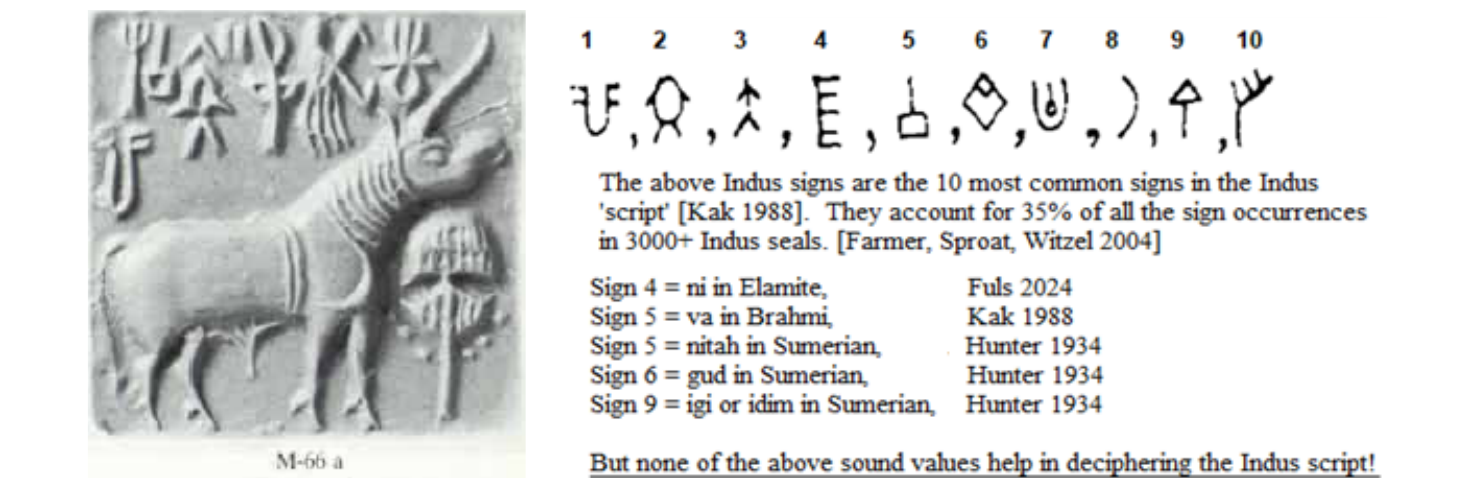
The first Indus seal containing what seemed to be writing was found in 1875. By 1929, thousands of seals and seal impressions had been found. They bore inscribed images and/or glyph-like signs; see Figure 4a. Perhaps understandably, scholars simply assumed that the Indus seals contained unreadable writing in an unknown language. It would not be till the 21st century that such a casual assumption would be questioned by Farmer, Sproat and Witzel (2004). However, many aspects of that paper were criticized by Parpola (2005, 2007). Rao et al. (2009) claimed to have disproven the not-a-script thesis, eliciting a sharp response from Farmer, Sproat, and Witzel (2009). Despite these three authors, most scholars still believe that the Indus seals do bear written inscriptions.
Since the first detailed study of the Indus script by Hunter (1934), there have been nearly 70 Indus script decipherment attempts. The books or papers, now available online, of Heras (1953), Mahadevan (2002, 1982), and Parpola (1994) explain why the more famous decipherments were not accepted by a majority of scholars. Most decipherment attempts have assumed that the script encodes Sanskrit or Dravidian. The Sanskrit-based decipherments were dismissed for linguistics-related reasons, but now they can all be dismissed in light of the new genetics-based evidence, which clearly shows that Indo-Aryans, hence Sanskrit, first entered the IVC region only during the 2nd millennium BCE, when the IVC was in its decline and seal production had stopped. As stated earlier, languages in pre-state societies usually spread through human migrations. The orthodox opinion among scholars for over 60 years has been that the IVC seal writing is in PPD (which they refer to as Proto-Dravidian or just Dravidian), even though, as Farmer, Sproat and Witzel (2004) have pointed out, such an assumption has failed to produce a single, verifiable reading. However, Dravidian place names ending in ‘paLLi’, ‘vali’ or ‘wari’ can be found even today from the Indus valley to central India (Witzel, 1999). Such names may predate 300 BCE, since Jain literature mentioning ‘paLLi’ is from that date (Sankalia, 1949).
The Indus script was contemporary (2800–1900 BCE) with the Linear Elamite script. In Elamite Iran, the first Proto-Elamite tablets with writing in the Proto-Elamite script first appeared in 3100 BCE; they bear a clear resemblance to the proto-cuneiform Sumerian tablets of the Mesopotamian Uruk IV period, which antedated the tablets by 100 years. A few still question Desset’s recent full decipherment claim of the Proto-Elamite and Linear Elamite scripts, but Linear Elamite is considered partially deciphered, due to the earlier efforts of Mader (Fuls, 2024). Only one of the 10 most common Indus signs (see Figure 4b) has an equivalent in Linear Elamite (Fuls, 2024), so an impending decipherment of the IVC script is not likely. Bronze Age Jiroft, near the IVC, had an entirely different script from the IVC (Basello, 2006).
Though Mahadevan (1998) held that the IVC was monolingual (and Dravidian), it is possible that the writing on different seals may encode different languages, greatly complicating any decipherment attempt. The case for a multilingual IVC is strong and is discussed in the next section.
6. Possible IVC Languages
6.1 PDr1 as an IVC language
Narasimhan et al. (2019) showed that the ancestors of the IVC people were formed by admixture between Iranian farmers and SAHG/AASI, during 5400-3700 BCE, i.e., before the IVC began, in north-western India and Pakistan. The work of Bomhard (1996), Pejros and Shnirelman (1988) and McAlpin (2015) suggests that the eastern dialect of Proto-Zagrosian became PDr1 in 5000 BCE or 4000 BCE (Andronov, 1964). So, it is likely that IVC’s forefathers spoke PZ and, later, PDr1, which probably accepted loanwords from the language/s of the SAHG/AASI when they interbred with the Iranian farmers. The oldest settlement in the Iran-Pakistan area is Mehrgarh, Pakistan, which dates back to 7000 BCE; PDr1 speakers may have lived in Mehrgarh’s Periods 2 and 3 from 5500-3500 BCE. The nearby Helmand Culture cities, Shahr-i-Sokhta and Mundigak, had trading links with the IVC, so they too may have hosted PDr1 speakers. PDr1 may have been the major language of the IVC during much of its existence, except perhaps during its decline. PDr1 was probably linguistically closer to PZ and Elamite than to PPD. If PDr1 was the language of the Indus seals, that may explain why scholars have been unable to read PPD into the seals.
If PDr1 got replaced by PPD, that cannot be discovered from the still-undeciphered Indus seals. However, Witzel (1999) points out that Hinduism’s oldest book, the Rigveda, composed in Vedic Sanskrit by Indo-Aryan immigrants to the IVC area during the declining centuries of the IVC, contains important clues. The Rigveda has been chanted unchanged and memorized by India’s Brahmins since its composition in the 2nd millennium BCE, so it is like a tape-recording, according to Witzel who bases his quest for Dravidian and foreign loanwords in the Rigveda on Kuiper’s list of 380 such words which form only 4% of the total word count of the Rigveda. Witzel writes that the Rigveda reflects the Punjab province of Pakistan and India from 1700-1200 BCE. This date range agrees very well with various genetics studies that show that one or more waves of Indo-Aryans entered India in the 2nd millennium BCE. Witzel assigns each of the 10 books, except book 9, of the Rigveda to the following three layers: i) the early Rigvedic period from c.1700-1500 BCE, ii) the middle Rigvedic period from c.1500-1350 BCE, and iii) the late Rigvedic period from c.1350-1200 BCE.
Witzel reports that the early layer of the Rigveda contains no Dravidian words, but they suddenly appear in the middle layer and the late layer of the Rigveda. It is exciting to imagine that the tape-recording that is the Rigveda might have caught PPD soon after its birth during the middle Rigvedic period, but that is too good to be true! As van Driem (1999) points out, it is more likely that Indo-Aryans met Dravidian speakers for the first time in post-IVC Punjab of the 15th century BCE. PPD may date back to around 1800 BCE (Southworth, 2011), i.e., after the start of IVC’s decline, as discussed later. By that time, seal production had stopped, so the writing on the seals cannot be in PPD.
6.2 Para-Munda as an IVC language?
Witzel (1999) also claims that, in addition to PPD words, the foreign words in the Rigveda also include “Para-Munda” words of apparently Austroasiatic origin. Witzel tries to show that the Para-Munda substrate was the predominant language of the IVC. As van Driem (1999) points out, the case for a Dravidian Indus is still intact, with or without the Para-Munda substrate in the Rigveda or the IVC. In his paper, Witzel admits that he is not a Dravidian specialist. Krishnamurti (2003: 38–39), who was one, points out that Nikita Gurov has shown that several of Witzel’s Para-Munda words have Dravidian etymologies based on compounding and not prefixing and comments that it would have been better if Witzel had said that he did not know the true source of the 300+ borrowings in the Rigveda.
Probably because Para-Munda was confused with Proto-Munda, Witzel renamed Para-Munda as the Kubha-Vipas (K-V) substrate (Witzel, 2009), which may or may not have been related to the Munda languages. Because Southworth’s standard work (2005: 68) writes that Old Indo-Aryan had Munda/AA words, Witzel’s Para-Munda or K-V hypothesis is further discussed below.
The Munda peoples, classified as Scheduled Tribes by the Indian government, still live in eastern central India (see figure 1), except the Munda-speaking Korku tribe, who live in central India. The Munda people speak the eponymous Munda languages, which belong to the Austroasiatic (AA) family, which today is found in Southeast Asia, especially Cambodia, Laos and Vietnam, where AA speakers form the majority. The Munda’s mostly male AA ancestors migrated from south-east Asia to east India 4.3 kya according to Arunkumar et al. (2015) and 2 to 3.8 kya according to Tatte et al. (2019). These dates make it impossible for Munda speakers to be in the IVC, 2000 km away. An earlier genetic study by Zhang et al. (2015) had the Munda arriving in East India 10 kya, but this study seems to have been superseded by Tatte et al. (2019), who cite it. Most speakers of Ho, a Munda language, live in East India, but a few live near Punjab. So, the latter must be recent migrants to the area and could not have interacted with Indo-Aryans. Also, the Modern Indian Cline on which most present-day North and South Indians fall (Narasimhan et al., 2019) neither needs nor includes the Austroasiatic speakers’ genome.
If the Rigveda indeed contains K-V words, they need to be from an unknown non-Munda AA source, which somehow did not contribute to the Modern Indian Cline, but this is special pleading. It is more probable that there are no Para-Munda or K-V words in the Rigveda (Krishnamurti, 2003: 38–39; van Driem, 1999).
6.3 Language X and Meluhhan as IVC languages?
Witzel (1999) also says that the Rigveda’s Para-Munda substrate overlays a still older local level, which may be identical to Masica's "language X" of the pre-Aryan Gangetic plains. Language X had been proposed by Masica (1979), who found that 80% of the agricultural terms in modern Hindi cannot be traced to any other language, extinct or extant. Masica (1979) did not examine if these agricultural terms were part of the vocabularies of languages ancestral to modern Hindi, but Southworth (2005: 66–69) says that they are of general occurrence in Indo-Aryan, so he says that it is reasonable to posit the “Indus” languages as the source of this material.
Meluhhan was proposed as an IVC language by Southworth (2005: 64–66) and Witzel (1999). Meluhhan is needed to explain the 40 non-Dravidian loanwords in Sumerian that refer to goods from Meluhha, which is identified by scholars as the IVC. Meluhhan might have been spoken only in the Balochistan-IVC border region, according to Southworth and Witzel.
As Narasimhan et al. (2019) found, the Iranian farmers who were the source population of the IVC, along with the SAHG, had up to 10% Western Siberian Hunter-Gatherers (WSHG) genome due to admixture during their stay in eastern Iran. So, the unknown WSHG language might have influenced the IVC’s languages.
Thus, the languages of the IVC’s early and mature phases may have been PDr1, Meluhhan and Language X, all of which may have had SAHG and WSHG loanwords. Another possible but very unlikely IVC language may have been an unknown Austroasiatic language like Witzel’s Kubha-Vipas. During the late 2nd millennium BCE, in what is now North India and Pakistan, all Bronze Age languages (except perhaps Brahui and Burushaski, both spoken only in mountainous areas) got replaced by Old-Indo-Aryan (OIA) dialects, i.e., Sanskrit dialects, while multiple waves of Indo-Aryans mingled with the IVC population. Their descendants, the ANI who had some ASI genome, spread across north India and Pakistan, along with Vedic Hinduism. In the next millennium, OIA dialects gave way to Middle Indo-Aryan, alias Prakrit languages, whose daughter languages are still widely spoken today (Southworth, 2005: 44–47).
6.4 Bronze Age Language/s of the SAHG in South India
The question as to which languages were spoken by the SAHG living in southern India during the IVC period before contact with southbound IVC migrants cannot be answered at present. However, Southworth (2005: 66, 329) suggests Proto-Nilgiri as one of the non-Dravidian languages of South India, which preceded the arrival of PPD. Zvelebil (1990: 63–70) listed a few words from Southworth’s Proto-Nilgiri which are now found in the substrate in Irula, a Dravidian language closely related to Tamil. It is important to note that Southworth uses the term ‘Proto-Nilgiri’ to refer to a non-Dravidian language, whereas the Starling Database uses that term to refer to the Dravidian ancestor of the Irula language. The Irula scheduled tribe was once mistakenly bracketed with Australia’s Aboriginals as part of the ‘Australoid race’, because of their phenotypic resemblance. Today, genetics has proven that the Irula are genetically the closest South Indian population to the AASI and have no Australian genome (Yelmen, 2019). As Witzel (1999) points out, more research on the pre-Dravidian substrate in Tamil, Telugu, etc. is needed. Besides Southworth’s Proto-Nilgiri, no other non-Dravidian language has been inferred as a language of the South Indian AASI. It does not seem impossible that two endangered language isolates in southern South Asia, i.e., Nihali (Nahali) and the Vedda language, now spoken by small tribal populations, may be relics or descendants of the original languages of the AASI people before they started speaking Dravidian.
7. Zagrosian and Dravidian Family Tree
In southern India, the Southern Neolithic Archaeological Complex (SNAC) and other neolithic sites are from 2500 BCE onwards. The claim that the Iron Age started in Tamil country in 3345 BCE is almost certainly false (Krishnan, 2025). In his book, Southworth (2005: 49, 245) repeatedly states that SNAC (see figure 2) should be associated with Proto-Peninsular Dravidian. But in a later paper (Southworth, 2011) written after he started subscribing to the Proto-Zagrosian theory, Southworth admits that other languages may have been spoken in the SNAC area before they were completely replaced by PPD, perhaps sometime between 1800-1200 BCE, i.e., during phase III of the southern Neolithic age. So, the dates that Southworth (2005) suggests in his book for PPD and PSD are some 500 years too early, and his 2011 paper has more accurate dates. Southworth’s (2011) suggested timeframe (1800-1200 BCE) for PPD in the Southern Neolithic seems to be now confirmed by the new archaeogenetic evidence of Narasimhan et al. and other such papers, which show that the ASI and ANI populations formed between 2000-1000 BCE, and by archaeological evidence. The 1800-1200 BCE timeframe also agrees with Dravidian words appearing in the Rigveda, which was composed during this period in Northwest India.
Based on the new genetics studies and the earlier linguistic studies of several previously mentioned authors, the Zagrosian superfamily’s linguistic tree is shown in Figure 5, which merges the Proto-Zagrosian model of McAlpin and Southworth with the relevant part of the Dravidian family tree (Krishnamurti, 2003: 493). The language splits and dates from various references are given in Figure 5, and the 3900-year time-depth of PPD in Figure 5 broadly agrees with the Bayesian phylogenetic study of Kolipakam et al. (2018), which concludes that the Dravidian language family is 4.5 kya old.
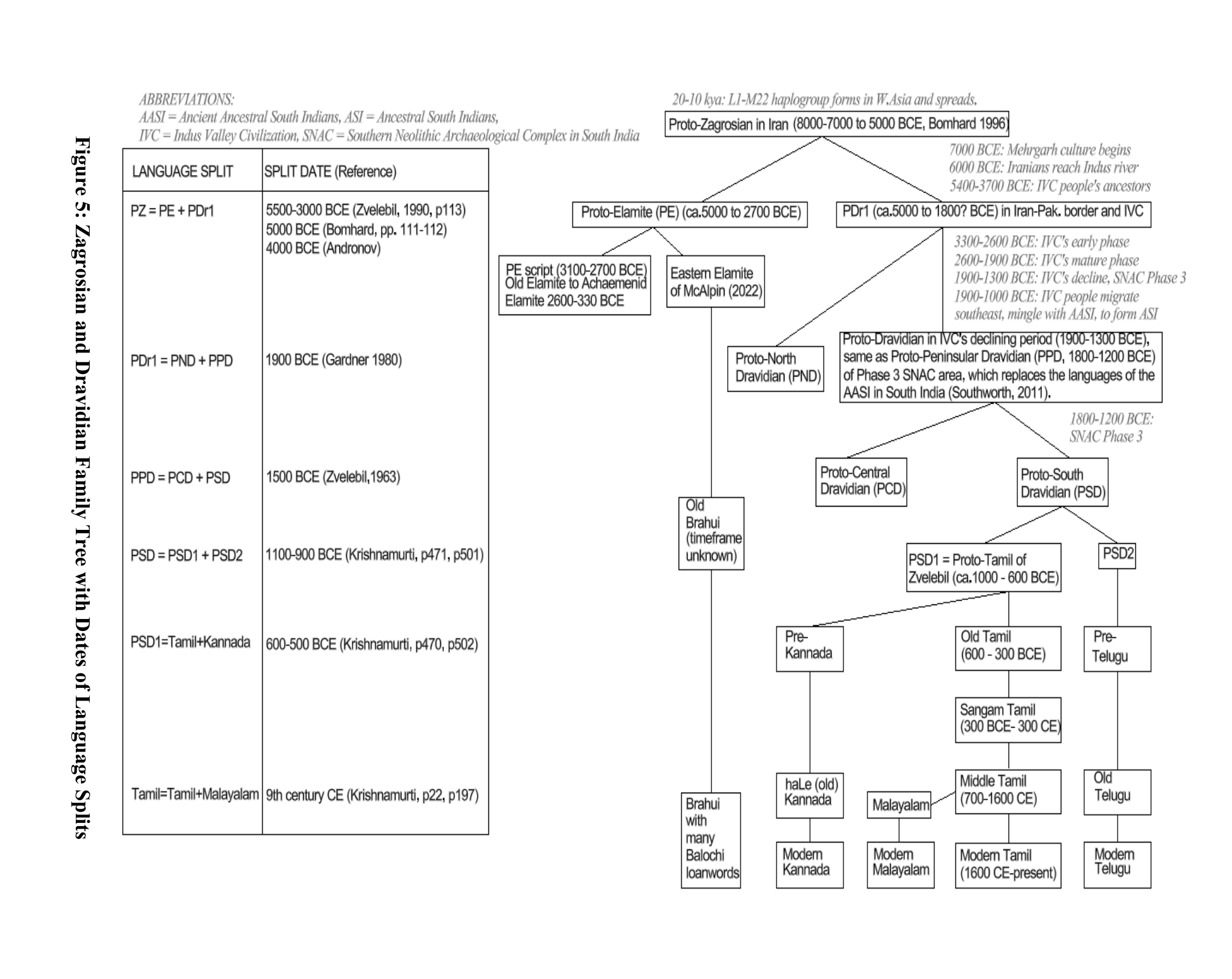
Pejros and Shnirelman (1988) used linguistic archaeology, i.e., the reconstructed PPD words (available in Southworth (2005b)) for some food crops, especially wheat and barley, and paleobotanical finds of these in archaeological sites to suggest that PPD originated in a dry deciduous forest region where wheat and barley were grown along with some rice, sorghum and African millet. The only archaeological region where these can all be found together is in the southeast corner of the IVC (see figure 2), where the post-IVC Kayatha and Ahar chalcolithic sites are, 1000 km north of SNAC. The authors claim that from this region, agricultural expansion occurred eastward and southward. This agrees with the finding of Narasimhan et al. (2019) that IVC people migrated in these directions before the formation of the ASI. So, it is likely that the PPD-speaking newcomers to Phase III of SNAC originated in Kayatha and Ahar, and agriculture may have played a role in the replacement by PPD of the original languages of the SNAC. Southworth (2005b) writes that PPD was spoken in eastern central India because the daughter languages of PND, PCD and PSD are now spoken around this area. His assertion is compatible with the papers of Pejros and Shnirelman, and Narasimhan et al., if we take eastern central India as the second home of PPD before its split into PCD and PSD in 1500 BCE (Zvelebil, 1963), as shown in Figure 5. Perhaps, a few PPD speakers migrated from Kayatha and Ahar to Punjab also, explaining the presence of PPD words in the middle layer of the Rigveda.
8. The Origins of Proto-Zagrosian?
Proto-Zagrosian’s possible origin in the Fertile Crescent near Anatolia is thought-provoking after one reads Heggarty et al. (2023), who describe their use of linguistics and genetics data to reconcile the Anatolian theory of the origin of Proto-Indo-European (PIE) with the rival Kurgan theory, which holds that PIE’s original home was the Steppe. They suggest that PIE originated 8 kya in Anatolia, and its speakers migrated to a new secondary home in the Yamnaya Steppe and then over much of Eurasia.
PZ and PIE are members of the proposed Nostratic superfamily of languages, a concept which is widely rejected by historical linguists except long-rangers like Kerns, who wrote that the Fertile Crescent may have been the original home of Nostratic (Bomhard, 1996: 128–129). However, genetic studies reveal no Anatolian genome in modern Indians (Pathak et al. 2024), weakening this hypothesis.
Pagel et al. (2013) include Dravidian in their Eurasiatic superfamily along with PIE, but this paper attracted much criticism on linguistic grounds (Heggarty, 2013 and Thomason, 2013). Pagel et al. have Dravidian originating in Siberia, which is now contradicted by the new genetics papers mentioned earlier. The Uralo-Dravidian connection studied by Pudas-Marlowe (1974) in her dissertation cannot be dismissed, according to Southworth (2005: 49). Susumu Ohno tried to prove a relationship between Tamil and faraway Japanese. Both Zvelebil (1990: 116–118) and Krishnamurti (2005: 45) refuted his claim. History records that Tamils interacted with the Japanese for the first time only during the 20th century CE. Dravidian’s possible connections with other languages or families have been investigated, but Austerlitz (Krishnamurti, 2005: 43) concludes that such studies, often done by amateurs, are unsystematic and wrong.
9. Conclusions
- Because of the new archaeogenetics evidence, linguists should take a second look at the Proto-Elamo-Dravidian or Proto-Zagrosian family trees of McAlpin and Southworth, whose timelines, based on older linguistic studies, agree very well with the new genetic evidence.
- There is more evidence supporting an origin in the Indus Valley Civilization (IVC) than for a more ancient origin within India, for Dravidian, which seems to be a daughter family of the Zagrosian superfamily of Elamite Iran, as shown in Figure 5. That figure summarizes the genetic, linguistic and archaeological evidence discussed in this paper.
- PDr1 (the mother of Proto-Peninsular Dravidian (PPD)), Meluhhan, and Language X may have been the languages of the IVC. Since these are unreconstructed languages, deciphering the IVC seals would be very difficult, explaining why 70+ decipherment attempts have failed.
- Proto-Peninsular Dravidian (PPD) emerged during the IVC’s decline in the 2nd millennium BCE and was taken by migrating IVC people to South India, where it replaced the languages spoken by the Ancient Ancestral South Indians (AASI) who interbred with the newcomers. How and why this language replacement happened is not clear, but it is relevant that Sanskrit dialects replaced the Bronze Age languages of North India. Proto-Peninsular Dravidian (PPD) may have borrowed AASI words, and there may be a hitherto undiscovered substrate in today’s Dravidian languages whose descent from PPD is shown in Figure 5.
Acknowledgement
The author thanks the anonymous referee who gave him the list of additional references, which can be found below the next section, and recommended its inclusion.
References
Additional References
The additional references given below by a referee are very useful to Dravidian scholars. The paragraph below classifies the bibliography given in this section, into various topics.