Language Origins and Group Behavior:Proto-speech, Syntactic Language, and Spread of Language
Abstract
The emergence of human language is explored here through a focus on group behavior of humans and other animals, leading up to the assertion that creolization was the final step in creating fully syntactic language, 70,000 years ago. Group behavior generally relies on animal perception of environmental information – audio, visual, and other – and on signals emitted and exchanged among organisms. Groups are widespread in the animal kingdom, with their communication enabling successful species to build new environmental niches and expanding domains. Applying this logic to hominin species has revealed social groups characteristic of primates, focusing on touch, grooming, gestures, and odor. Hominins later developed types of audio exchange, especially calls to assembly of groups for scavenging, which led with time to creation of words as vocalizations of specific concepts. Assembly of words by small groups yielded “proto-speech,” in which group members could exchange phrases of up to four words, but with only elementary knowledge of their links.
A process of creolization led from proto-speech to fully syntactic language. Young Homo sapiens had gained the genetically-based capacity to organize words into hierarchical order and sentences but could apply it only when they were collaborating in autonomous and persistent groups. This hypothesis, proposed in an abstract model, is supported by evidence on the invention of Hawaiian Creole English, Nicaraguan sign language, and debate on creolization, showing that native creole speakers rapidly created successive syntactic processes. The same studies give evidence of such non-linguistic aspects of creolization as social patterns of group size, brain-based individual language archives linked to group discourse, and social institutions to sustain the language. The model is then applied in a hypothetical narrative of the rise and expansion of fully syntactic language.
Keywords: group behavior, proto-speech, creolization, fully syntactic language, universal grammar, we-group, social evolution, institutions
Introduction1
The historical study of human language continues to advance on many fronts. But for the origins and early development of spoken language, current study is complicated by several debates. In one debate, scholars ask: how far back in time can one explore the history of language and its groups of speakers? For those who see sharp limits, the practice of reconstructing ancestral languages can be pursued only as far back as mid-Holocene times, for lack of adequate lexical data. In contrast, contributors to Mother Tongue have explored aspects of language for earlier times, for instance by projecting certain words of the putative Proto-Human language.2 A second debate centers on the pace of linguistic change.3 Did the complexity of syntactic speech require that it developed gradually over the millennia? Or could the creation of syntactic language be sudden? A third debate asks: is language a uniquely human capability?4 For those who defend human uniqueness, the dynamics of language can be explored only in human audio communication. But others see parallels in communication among species, arising from flows of information and group behavior among animals broadly.
Derek Bickerton has been prominent in the second and third of these debates. On the pace of change, Bickerton’s theory of “language bioprogram” (1984) argued that creole languages were created rapidly by children who relied on universal grammar (UG) to create syntax within the span of a single generation.5 Bickerton then challenged the uniqueness of language, conducting cross-species analyses that combined linguistics and evolutionary biology. His expansive view of biology included not only natural selection but the newer analyses of epigenetics, niche construction, and expanding neural systems. But Bickerton gave little attention to patterns of group behavior, another rising area of biological study.6 Thus, a recent exploration of group dynamics offers the following summary of group behavior’s significance in biological evolution:7
Collective behavior is common at the molecular, cellular, and organismal levels, from flocks of birds and insect task allocation to the coordinated movement of cell groups during embryonic development. . . . Individuals perceive their surroundings and the states of other individuals through visual, auditory, and chemical signals, making behavioral decisions accordingly. These local interactions can lead to global collective behavior.
This essay reaches across numerous species and long spans of time to identify links among group behavior, communication, and eventually language; it takes positions on all three debates about early language. For times from 400,000 years ago, it poses hypotheses tracing specific steps toward human spoken language. The essay acknowledges that human speech is unique among animals yet reaches still further back to argue that all communication depends on group behavior, tracing animal groups and exploring parallels of human and animal groups that help explain communication through speech. Further, while many aspects of human and animal communication developed gradually, the breakthrough to syntactic language was arguably sudden and innovative.
In the absence of direct evidence on the origin of Pleistocene-era language, unraveling its puzzle can best rely on the modeling of modern creoles. Bickerton’s 1981 formulation was that the rise of modern plantation creoles, in which children’s experience with their parents’ pidgin communication engaged their inherent syntactical skills, resulted in elegant, simplified, and remarkably similar creole languages. This, Bickerton reasoned, was a prototype for the Pleistocene-era creation of an initial creole out of the pidgins of parents. For his model, Bickerton chose Hawaiian Creole English as the best-known example of a modern creole. In addition, I have included the case of Nicaraguan sign language: it is well documented and adds important variance. This case shows that children, if denied audio communication because of deafness, turned their impulse to communicate toward the next sensory option, that of visual communication through gestures.
Human children, in initiating speech, articulated their genetic capability to organize concepts hierarchically but could not apply it either in audio or visual expression until they overcame the barrier to their group collaboration. Only once young children found themselves in groups of some permanence, autonomy, and sufficient size (about 15 children), were they able to exchange their syntactic formulations and create the beginning of a fully syntactic language. Modern children lived in a world filled with institutions facilitated by language, which gave order and structure to life—even if they were the oppressive institutions of plantations. Pleistocene children, in contrast, had no institutions until they created their own patterns governing language use.
Throughout this essay, an effort is made to maintain contact with issues raised in the opening section on early animals: sense perception, links among individuals, and the rise of group behavior. These processes have retained their roles in the developments of later steps in evolution, all the way to spoken language and beyond.
Early Animals, from Sense Perception to Groups
Group behavior had its origin in early evolutionary times, with the interaction of animals and their environment.8 The global environment, even at the time of single-celled organisms over three billion years ago, encompassed the full extent of the Earth’s waters, lands, and skies. Not just the masses and physical forces of the environment but also the waves of information about them echoed across the planet. Within this environment, multicellular animals first emerged some 800 million years ago. These organisms, with their nucleated and differentiated cells, evolved out of single-celled organisms.9 Their animal existence centered on material systems existing in a given environment, with intake of food, liquids and gases, accompanied by the internal circulation of that material and the expulsion of waste materials from the body. The successful early development of these tiny yet differentiated animals is reflected in the wide range of their descendants, who have adapted in form and function to the immense variation in the Earth’s environment.
But early animals, buffeted by all the forces of the environment, had to adapt to environmental pressures. In order to thrive, animals gathered information on the dynamics of their environment: information on the Earth’s physico-chemical processes and also its biological organisms. Animals developed systems of sense perception, developed related patterns of neural exchange of information, and formed systems of bodily motion at individual and group levels.
The input structure of animal information systems began with sense organs. Within each type of early animal, specialized multicellular organs formed as receptors, able to identify specific elements of the environment, so that the organism could respond to them. Input categories included information on taste, motion, vision, touch (bodily touch and physical force), sound, odor, temperature, and balance. The neural system, transmitting information, linked neurons to receptor organs, translating chemical species and waves of light, sound, and pressure into electrical pulses transmitted through neurons, directing these electronic flows to ganglia and brains for interpretation and decisions on actions. The output system of motion and information received electronic messages and translated them into the flexing of selected muscles that moved body parts. Categories of output included bodily motion and touch, sound, and odor; in addition, information on bodily motion was carried by waves of ambient light as output. In sum, individual organisms gave reflexive responses to environmental information. For these reflexive motions, the reception of input data and response of movement completed the cycle of adjustment to the environment.10 For instance, the force of gravity is measured and then yields adjustments for bodily balance, while the touch of wind or water pressures may lead to body movement.
While some animals live mostly individual lives, most animals experience one or more types of group behavior, in which individual actions are compounded into group patterns. The first group pattern is the reflexive movement just described, in which a sense is received and an action results. The sense of taste tells an animal whether or not material is edible. For information on the touch of waves of water or sound waves, the organism may respond with motion. Where multiple organisms of the same species received a single environmental impulse, they responded in parallel, giving the impression of a group action even though the animals were responding to the impulse and not to each other.
The second group pattern is collaborative interaction, in which a sense is received from the environment and one organism responds by emitting a signal that reaches another. Signals included the emission of chemicals for smell, bodily action for touch, and sound for hearing. These types of signal output, translated from the neuron-based messages to the action of output, enter the environment and may be received by the receptors of other organisms, especially of the same species. Another signal is visual, emitted indirectly as bodily motion gives rise to a visual signal through reflection in ambient light.
Beyond the emission of signals, a subsequent step allows for the creation of group behavior, especially groups of a single species. A first animal emits a signal that is received by a second; the second then selects a response and sends output into the environment. The first organism receives the output as input and makes its own response. In this way, collaborative groups arise, in which groups of organisms can generate coordinated responses to the impulses of the environment or the actions of each other.
The combination of the two types of group serves such functions as sexual reproduction, conflict (or peaceable relations) among organisms of the same species, defense against outside influences, and expansion of the species domain. The trans-species accumulation of individual, reflexive, and collaborative actions brought great diversity to the patterns of animal life. The diversity of animal life stretched across the scales of individual phenotype, sense perception, individual and group action, and species-level phenotype and domain.
The diversity itself arose through processes of natural selection.11 Natural selection is now understood to take place through overlapping mechanisms, affecting organisms at levels from the molecular to that of whole species.12 Darwin’s 1859 theorization used the term “natural selection” to refer to the process of change in an organism’s observable traits at both the individual scale and the species scale.13 After 1900, the field of genetics arose, focusing at the molecular level on DNA in nucleus and mitochondria for individuals and for sample populations. The slow pace of genetic change set the genetic instructions needed for an organism to develop and function.14 Epigenetic change, discovered in the 1960s, takes place through protein action, producing heritable changes in gene expression without altering the DNA sequence. It can lead to rapid change in phenotype and life-course development.15 Niche construction, unfolding at the phenotypical and species levels, reflects the actions of organisms in modifying the local environment, as in ways to get food.16 Niche construction feeds back with genetics and epigenetics in providing selective pressures on the genome and on life-course development. Further, neural evolution and expansion strengthened information transmission within organisms; while animal groups, both reflexive and collaborative, exploited varied environments and expanded species domains. The term “natural selection,” still in use, is increasingly understood to apply to the ensemble of these mechanisms that contribute to evolutionary change.
Trilobites, ubiquitous early animals, exemplify this diversification through natural selection. These Cambrian-period arthropods, with external skeletons, three main body segments, and averaging 3-10 cm in length, were commonly preserved as fossils.17 Trilobites had thousands of species and varied lifestyles; many walked the ocean bottom, others swam. Their compound eyes had numerous units of transparent calcite. Their groups included single-file groups for migration and defensive clusters during the molting of their shells.18 Such sense receptions and signals are certain to have developed at the early, pre-Cambrian stage of animal evolution, since they are known throughout the Animal Kingdom. The same processes—transforming environments as well as species—have continued ever since.
Reflexive and Collaborative Groups: post-Cambrian
The early Cambrian Period, from 540 ma to 485 ma, brought a rise in Earth’s temperature from a low of 12º to an average of 22º C, during which animals grew in size and formed almost all of the major animal subgroups – known today through fossilized remains of their shells and skeletons.19 The principal groups of species included arthropods (such as insects, crustaceans, and spiders), vertebrates (such as fish, amphibians, reptiles, and birds), and cephalopods (squids, octopi, and cuttlefish), along with smaller orders.20 All had full sets of sense perceptions; all relied on their senses to form groups and enact group behavior. Mammals and marsupials formed later among vertebrates, about 210 million and 125 million years ago.
Group behavior of animals, arising from sense perception, falls into the two main categories of reflexive and collaborative group behavior. For reflexive behavior, individual motions, reflexive responses and reflexive groups yield the basic results of sense perception. These responses rely on the “environmental” senses: information on taste, gravity, magnetism, temperature, and the touch and pressure of wind, water, and solids. In present-day examples of reflexive responses, Atlantic herring and other fish form tightly linked “schools” of thousands of individuals for rapid movement, for instance to loci of spawning. The schools function through each organism’s response to pressures and touch from the larger group.21 No fish sends a signal: instead, the physical waves generated by the swimming of each provokes adjustment to its course and resultant waves to be felt by others.22 In the atmosphere, somewhat parallel waves are created by the flight of birds, so that geese and some other large birds fly in V-formation. Each tailing bird benefits from the updraft formed by the birds ahead of it, making flight more efficient. On land, reflexive groups do not function as smoothly as in water and air, but antelope and other ungulate mammals run in formation, relying on vision to set their distance from each other. A quite different sort of environmental sense enables animals to choose direction. These animals, including some snails, contain fragments of iron oxide to sense the direction of the magnetic poles for orientation. In a spectacular such case, individual Arctic terns migrate annually between the Arctic and Antarctic, relying on this sense for navigation.23 These few examples suggest how reflexive groups function. There appear to be great numbers of reflexive actions and groups at individual and group levels, and they overlap with collaborative groups. Over the course of evolution, growth in numbers of neurons in many animals is likely to have deepened the sensitivity of information and reflexivity.24
Somewhat more complex are the collaborative groups, which arise from the smaller number of “collaborative” sense inputs, which may lead to emission of signals that ultimately link organisms into a group. The types of collaborative input and output information include: direct and bodily touch; olfactory information that diffuses the odor of small chemical species; and for audio, sound waves of various frequencies, emitted by types of bodily friction. For signals of motion, motions may be reflected in ambient light, both at the level of formulating motion and the level of propagating information on the motion.
Recent research has documented collaborative group behavior in a wide range of animals.25 The brief examples included here give indications of the range in species known to act in groups and the distinctive group activities of each species. On the behavior of ants, naturalist John Lubbock showed in the 1880s that ants used odor trails in foraging.26 An ant, after finding food, leaves a trail of pheromones or chemical traces on a trail back to the nest, which enables others to find the food.27 Ants are now thought to make sounds as well, especially at the pupae stage. Bees rely especially on two types of visual links through “dance” in showing paths to flower blossoms. In the 1920s, Karl von Frisch described how bees returned to the hive and performed the “round dance” to locate nearby feeding places and the more complex “waggle dance” for distant blossoms, identifying the direction and elevation of the blossoms.28 Bee observations depended on scent, color, magnetism, and using their compound eyes. Bees observing each dance translated and acted on the message. In each of these cases, collaborative groups exchange information and take action of value to the group.29
Among primates, the vervet monkeys of East Africa developed distinct audio warnings against their main predators: leopards, eagles, and pythons.30 The leopard call signals the need to climb a tree; the eagle call signals the need to look up and hide under a bush. Beavers in North America and Eurasia respond to the sound of running water by building dams; the resulting ponds provide homes for numerous plants and animals and include beaver lodges with underwater tunnels for entry. Beaver mates and their offspring maintain their groups with links of scent, vision, touch, and audio, working collaboratively in maintaining dams and lodges. Beavers eat wood and other vegetation; they are strong swimmers and can hold their breath for six minutes.31 They groom their own and others’ hair for waterproofing; glands excrete castor oil for grooming and for marking territory against invading beavers. A slap of the tail warns against danger. Young beavers will travel as much as ten kilometers to find a space for building a dam.
These and other cases are studied within the field of Animal Communication Systems (ACS), a subfield of ethology or animal behavior.32 The forms of signals vary greatly by species, but their functions are much the same, conveying messages on survival, reproduction, and the social order.33 Much early work in ACS was phenotypical description of animal groups. Animal signals include bodily movement or display, facial expression, gaze-following, color change, and bioluminescence. Audio signals are conveyed through stridulation (friction of body parts) and by vibration of swim bladders in bony fish. Chemical links are complex but are under study. In general, animal communication responds to external stimuli and focuses on the here and now, without details on time or distance. That is, Bickerton specified that ACS does not allow for displacement in time or space and can only convey whole messages.34
The study of African fruit flies has opened possibilities for expanded understanding of animal communication. For over a century, fruit flies have been essential experimental animals for study of genetics, so they are well documented. From 2012, Joel D. Levine expanded the study of their group behavior.35 Groups of from 6 to 24 flies were placed in containers and videotaped for 30 minutes, then reviewed in slow motion. Phenotypical description revealed links by scent, touch, sound, and vision, and showed that groups enable flies to balance their distance, facilitating feeding and egg-laying. Then the group interactions were coded for statistical analysis. As a framework for analysis, the researchers turned to Social Network Analysis (SNA), which had been applied for decades in study of human groups.36 The advantage of SNA was the ability to calculate patterns of small and larger groups, though it is difficult to specify which links are by touch, sound, or vision. Levine’s team found ways to quantify links among fruit flies, then went further and discovered a gene that influenced behavior in large vs. small groups, suggesting that flies could count their group size.37 Up to this point the team had advanced the study of animal groups to trace the interaction of multiple scales: the genetic base, sense organs, data on sense reception and signals, links among organisms, functioning of a group under SNA analysis, and species-level interpretation of group behavior. Thus, they have further opened discussion on how organisms respond to environmental signals with sense assessment and group behavior.
Senses and Group Behavior in Hominin Species
Hominin species came into existence some six million years ago among the primates of East Africa, as the region shifted from forest to savanna.38 Some of the primates moved west into remaining forests, where their descendants became chimpanzees. Those who remained in East Africa evolved into hominins—surviving by gradually shifting their habitation from trees to the ground and their diet from mainly fruit to leaves, flowers, bark, insects, small animals, and a few fruits. Here we focus on hominin evolutionary processes for sense perception at the micro level and on niche construction at the level of species and groups.39
By the time of the well-preserved Lucy skeleton of the Australopithecene genus, 3.2 ma, hominins had given up trees and fruit to become fully omnivorous and bipedal.40 With the change in environment and phenotype, hominin sense capacities are certain to have changed: for instance, hearing became more precise and able to distinguish sounds at a distance.41 One may also expect that the sense of gravity adjusted to bipedal balance, the sense of taste expanded to assess the wider diet, and vision became sharper at distances. The sense of individual touch may have remained largely the same, relying on interpersonal grooming. The Australopithecine species of this era formed a terrestrial omnivore niche, working with tools of bone and wood for wide-ranging foraging.42
Late in the era of Australopithecine species, from roughly 2.5 ma, a more productive lifestyle emerged: a catchment scavenging niche.43 In it, members of Homo habilis used stones to break open bones left from carcasses eaten by other species, and then consumed the nutritious bone marrow.44 Such bones were found near waterways or in stone outcrops. The pattern was confirmed since the cuts and scrapes on bones made by hominin were on top of the marks left by other predators who had exploited them first. This niche and the consumption of marrow helped to build the size of brains.
A new and adventurous hominin niche arguably emerged at about 1.8 ma. Derek Bickerton and biologist Eörs Szathmáry assembled the arguments of others to postulate confrontational scavenging, in which groups of hominin seized meat from newly deceased large animals.45 A key element of this lifestyle was the development of a recruitment call by adults to gather a crowd and go to the carcass site. The recruitment call had some parallel to the alarm calls of vervets: each call was a complete message for the here and now, and thus an example of an Animal Communication System. Once at the site, males drove off competing scavengers while females cut off meat using Acheulean hand axes, with edges able to cut through the skin and flesh of dead animals. The hominin scavengers then moved off with their meat, though their lifestyle also relied on omnivorous foraging. Meat consumption helped to expand brain size and neuron density, so that community groups grew to perhaps 70 members.46 Members of Homo ergaster were the first such beings, tall and lanky by comparison with their predecessors, and better able to run. Paleontologist Ian Tattersall emphasizes that the new species arose rapidly, through a system-wide epigenetic process rather than through gradual genetic change.47 In an important but still-undated transformation, at sometime within the past two million years, hominin species switched gradually from multiple mating to pair-bonding, eventually leading to the formation of households of an average five members. In this change, battles among adult males declined and mortality of offspring declined.48
Rapid creation of confrontational scavenging was followed by a long period of migratory expansion, from 1.8 to 1.2 ma, with little change in lifestyle or technology.49 In this era, H. ergaster spread throughout African highland savannas and H. erectus spread to Asian highlands. For these occasional migrations, I assume that groups of about fifteen hominins hiked the distances from one highland region to another, managing to cross the lowland regions before settling and building communities of 70 at their destination.50 Greater temperature tolerance and sensitivity presumably developed along with migration.
Hominin migrations were governed by at least two types of climate change, in response to variations in the Earth’s orbit about the Sun. The first pattern, the East African monsoon, facilitated migration and biological interaction along Africa’s Rift Valley, with alternate migrations to north and south.51 In addition to the yearly sequence of northerly and southerly winds, the monsoons brought relative humidity to Africa’s northeast for 11,000 years, then to the south for the next 11,000 years. Second, major worldwide climate cycles were documented based on Marine Isotope Stages, with 100 stages measured within the past two million years.52 These alternating periods of warm and cool climate encouraged hominin migration in warm, humid times at the peak of odd-numbered MIS cycles. The cycles averaged 36,000 years between 1.9 and 1.0 ma (MIS 71–23) and then became longer, averaging 103,000 years from 1.0 ma to 100 ka (MIS 21–5).
Human remains in African archaeology are scarce between 1.2 ma and 400 ka, a period of most of a million years. Aside from periodic migration, it appears that the hominin lifestyle remained consistent during that time. Nevertheless, the physical type of the leading species underwent changes: of the African hominin remains dated between 800 and 300 ka, most have been classified as H. heidelbergensis.53 For this species, one may propose three types of dates in its speciation: the time at which its lineage separated from its last common ancestor (likely H. ergaster), as far back as 1.2 ma; the time of its full speciation, roughly 400 ka; and the time of its extinction, roughly 200 ka. Its estimated community size was 120 members.54
The few known archaeological remains suggest only modest evolutionary change, such as greater precision in the shaping of hand axes.55 Excavations also show occasional use of fire and some hunting with hafted spears, although these occasional advances did not reach general usage until the Middle Stone Age (MSA), after 350 ka. Human populations rose and fell, though genetic efforts to identify population bottlenecks have yet to yield definitive results.56
During this long period of slow evolutionary change, continued reliance on confrontational scavenging eventually broke through the ACS limit on displacement. That is, vocalization gradually extended from the recruitment call to include a modest number of words and associated concepts that could specify time and space, which Bickerton categorized as the beginnings of “protolanguage.”57 Bickerton reasoned that early words arose from the high-end scavenging niche, from rare but recurring events of high impact such as flash floods, and from acts and words of negation to create the word “no.”58 Like the initial recruitment call, each word and its concept was developed by adults and adolescents who shared the experience behind the word.59 For many millennia there existed no syntax to link the words, yet each word was a step in complexity because it moved beyond the here and now, opening to distance in space and time: thus, a word might specify a “leopard” as a concept, designating a leopard at any time or place.60 Bickerton, while assuming neural change, did not allow for structured relationships among words in early “protolanguage.”61 Chomsky and Fitch, however, each emphasized that internal concepts came before spoken words, so that concepts and communication were not the same.62 A further limiting factor on the development of proto-speech was the limits on size and intimacy of social groups: words and gestures might be shared among small and localized groups, but there was yet no process for sharing them over large populations.
Social Groups, Proto-speech, and the Middle Stone Age
Recent decades have developed a picture of accelerating human evolution within the past 400,000 years. To begin with archaeological studies, recent digs have revealed five clear waves of migration from Africa into Arabia. The path of the migrants is not known, but archaeological finds in North Arabia show that the peaks in MIS humidity brought numerous settlers to the same region at 400 ka (MIS 11), 300 ka (MIS 9), 200 ka (MIS 7), 100 ka (MIS 5), and 55 ka (MIS 3). The settlements are documented by remnants of the stone tools in each period.63 The timing and distance of these Arabian migrations provide a model for migration throughout
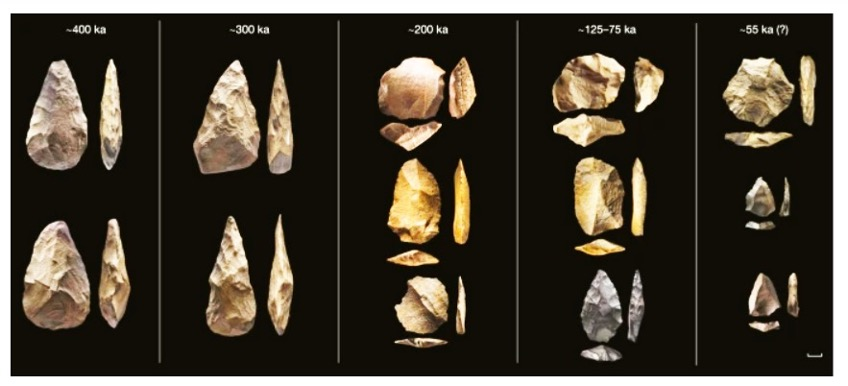
Africa, suggesting displacements of at least several hundred kilometers at times of the MIS peaks in humidity. The migrations at 400 ka and perhaps 300 ka were presumably of the heidelbergensis species; migrations of Homo sapiens likely included those beginning 300 ka and conceivably even 400 ka.
While archaeology and paleontology had long been the principal sources of information on human evolution, new understandings of biological evolution arose, from the 1960s, in adjoining disciplines. W. D. Hamilton’s theoretical work in population genetics showed that kinship was not simply from parent to offspring but that siblings and cousins also carried forth a closely related genome.64 The empirical notion of punctuated evolution, meaning occasional rapid change in phenotype (first documented for trilobites), led to theorizing the mechanism of epigenetics and to revived studies of life-course development.65 The notion of niche construction gained increasing empirical confirmation, so that feedback with environmental change came to be treated as part of natural selection overall.66 Genomic studies of modern and ancient DNA have tended to suggest relatively early dates for separation among species ancestors, hence earlier dates for speciation.67
For primates, after comparative studies revealed both intimate- and community-level groups in all species, comparison of fossil hominin crania showed community size to correlate with the size of the cerebral cortex, so that hominin communities grew from 70 for H. ergaster up to 150 for H. sapiens. All of these analyses have received some degree of empirical confirmation.68 Other biological hypotheses formulated after 1960, known in general as cultural evolution, have sought to show expanded collaboration in hominin behavior.69
How and when did Homo sapiens appear on the African scene? New data and analysis in paleontology have expanded knowledge and debate. The various dates of sapiens speciation may be estimated as 500-400 ka for separation of its lineage from that of its last common ancestor (separating sapiens from heidelbergensis and neanderthalensis); while its full speciation is estimated variously at from 350 to 200 ka. It may well be that such defining characteristics of H. sapiens as community size of 150 arose within the lineage before full speciation.70 The paleontology of H. sapiens highlights the Moroccan Jebel Irhoud skull, recently dated at 300,000 years ago.71 But no uniform phenotype in H. sapiens appeared until after 100,000 ka. In recent years, two models of speciation have gained most attention. First, Tattersall’s model of a distinctive population, arising through a broad epigenetic shift at about 200,000 years ago, led to rapid population growth and spread throughout the continent.72 Second, the model of Scerri et al. assumes an earlier and more gradual set of somewhat independent developments, with the nearly completed sapiens appearing widely by 300,000 ka.73
The concept and experience of the Middle Stone Age (MSA) brought together the analyses and discoveries listed just above. The MSA took form as recently as 280 ka and as early as 350 ka. The path-breaking 2000 review of McBrearty and Brooks demonstrated that innovation in the material and cultural practices of African communities expanded substantially during the MSA rather than wait for a “revolution” a scant 40,000 years ago. MSA stone technology relied on prepared cores, from which major flakes were broken off. Blades and microliths were then hafted to spear handles with glue or binding, especially in East and Southern Africa.74 Other expanded practices included hunting for large game, frequent fire for cooking; varying uses of ochre in decoration, and gift or exchange networks for obsidian. Meanwhile, Acheulean tools were abandoned by 130 ka.75 Archaeological sites of the MSA are described as a “mosaic” in that they exhibited regional and temporal variation in place of the continental uniformity of earlier times. The term “mosaic” is used as well to describe variations in bodily remains, whether within heidelbergensis, sapiens, or other communities.76
How were speech and language linked to the MSA? In exploring the development of hominin vocal communication, I follow a modified version of Bickerton’s “protolanguage”—a term that I replace with “proto-speech.”77 Bickerton proposed a sequence of steps in communication, beginning ca. 1.8 mya with the call to assembly that launched the long-lasting system of confrontational scavenging, followed by the gradual emergence of individual words and, after more than a million years, the rise of proto-speech with phrases of up to four words ordered arbitrarily as beads on a string until they came to be combined through elementary syntax such as noun phrases. Bickerton gave general indications on the timing of these steps but without links to hominin biological change or group social organization.78 More specific on both timing and topical connections was archaeologist Stanley Ambrose, who hypothesized two stages in the evolution of faculties for planning. For Stage #1, at the start of the MSA, he argued that manufacture of multicomponent artifacts, such as hafted spears, required an expansion of syntactic verbal communication, so that “composite-archive manufacture and grammatical language also coevolved.”79 Meanwhile, such other practices as grooming, gestures, dance, singing, and teaching likely brought modest advances in communication.80 Stage #2 of Ambrose’s argument, beginning about 70 kya, is discussed below.
Clearly, the MSA—including possible ties to proto-speech—amounted to a new hominin environmental niche. That is, hominin relations with the environment changed with the new uses of stone, fire, ochre, and more, linked by verbal and other communication. Altogether, these changes are likely to have generated feedback yielding selective pressures on the genome, bringing further phenotypic changes. While the changes in material culture are well documented, fuller analysis will be needed to clarify changes in group behavior and the scope of proto-speech. For instance, in what ways did hominin group organization change with the MSA? Few details are known. Overall community group size at 300 kya is estimated at near to 120, and it is argued that there were subgroups at various scales.81 But dates of emergence are not known for households based on pair-bonded couples, nor is it known what specific interactions among individuals formed the links in groups and subgroups (e.g. in voice, touch, gesture or other means).
For proto-speech, how widely and in what form did it spread during the MSA? Words developed in every region, yielding local versions of proto-speech rather than a widespread common lexicon. These versions of proto-speech, based on local invention, were spoken primarily by adults but also by children; yet the versions were not genetically related to each other in the way that later, syntactic languages were related.82 Pronunciation and meaning were learned by each individual; they were not inherited. Individuals stored words in brain-based archives and shared discourse among local group members. In my view, such local groupings did not permit the development of pan-human words, nor perhaps even words shared by a full hominin community of 150.
This scattered nature of proto-speech may nevertheless have brought the beginnings of universal grammar. As toddlers sought to identify patterns in adult speech, they found rules for certain patterns in word order—common rules that could be applied within varying proto-speech versions.83 Over time, the rules could become instinctual through gradual genetic change. Children thus gradually developed instincts in understanding some of the basic proto-speech of adults. But the MSA social order did not combine small children into persistent groups, so the children were unable to share their skills and expand their own syntax. This barrier remained in place for some time. Aside from these limits, however, proto-speech and its elementary syntax likely provided an important advance in communication during the MSA
Comprehensive Syntax, Discourse, and Social Institutions
The Proto-Human language arguably arose not as the genetic offspring of an earlier language but as a creole invented de novo, in a fashion comparable to that for other creoles in later times. To illustrate this argument, this section begins by illustrating the dynamics of creolization through compact narratives of two modern cases of emerging pidgin and creole languages. I turn then to a review of creolization theory, especially from 1980 to 2000, showing how initially eclectic approaches came to be dominated by universal grammar in a generative approach, yet with continuing complexities. The section concludes with four groups of hypotheses on the rise of the Proto-Human language through creolization in the Pleistocene era.
Two outstanding cases of creolization. The story of pidgin and creole speech in Hawaii began in the 1820s, when a “stable and expanding pidgin” began to form in the small initial sugar industry, relying on immigrant adults, with a lexicon based on the dominant Hawaiian language.84 This pidgin was destabilized in the late 1870s by a large-scale immigration of foreign sugar laborers, speaking over ten languages, continuing to 1930. Plantation workers developed a new pidgin: “Hawaiian Pidgin English” (HPE) had unstable structures from the many substrate languages and a lexicon from the English of plantation owners. It became the native language of the children of migrants from 1880 to 1900. The second generation of children, born between 1900 and 1920, drew on their capacity for universal grammar and shifted from HPE to a smoother and more sophisticated Hawaiian Creole English (HCE): this became the dominant language among young people of the plantations thereafter. Ironically, the creole language, HCE, is now popularly known as “Pidgin” by its speakers.85
In the Nicaraguan story, creolized sign language for the deaf arose through social revolution. The Sandinista Revolution in 1979 brought a program of schooling for all. From 1980, deaf children were brought from isolation to public schools – especially the Moreno primary school in Managua—with the intent of teaching them Spanish. The children did not learn Spanish but, on buses and at play, they developed a sign language of their own from about 1981. Their initially eclectic signs formed a “Lenguaje de Señas Nicaraguënse” (LSN)—a signed pidgin or jargon for which the constituents had no domination by a superstrate language. Then as early as 1983, some of the younger children at the Moreno School had begun to share a creole, “Idioma de Señas Nicaraguënse” (ISN). The children learning to sign at age 8 or more learned LSN, with its large gestures, while those learning to sign at age 7 or less learned ISN with its smaller gestures and more detailed sentences. Each language developed a growing lexicon and syntax. They interacted with each other and with a third language, an asymmetric pidgin bridging the gap between the deaf children and adults who were Spanish-speakers. MIT linguist Judy Kegl, arriving in 1985, worked for years with the program, researching student signing and supporting teaching in LSN and ISN.86 With time, speakers of LSN and ISN pooled their resources to build a student association, first to support the existence of the group, then to perform other tasks in the society. By 1999, the signing community of Managua had reached some 500 members; at the present day it has reached roughly 3000 members.87
Creolization theory. Scholarship in pidgins and creoles expanded rapidly from the 1970s, especially with empirical studies, until theoretical issues arose and brought two decades of intense debate, from 1980 to 2000. The results led to a substantial clarification and sharpening of theory, a great expansion in data, and wider recognition of the importance of creolization. Derek Bickerton did most to launch the debate with his two-part manifesto: a rambling but insightful 1981 book, Language and Species, and his more structured 1984 article, “Language Bioprogram Hypothesis,” which was accompanied by 25 commentaries and Bickerton’s response.88 His publications supported generative analysis, inclusion of evolutionary biology, and a focus on plantation societies as the essential source of creole languages. As he saw the plantation model, immigrant laborers with varied first languages, in slave or indentured status, encountered each other and rapidly constructed a pidgin language without structure, drawing elements from many substrate languages but with a lexicon relying primarily on the superstrate—in Hawaii, the dominant English-speaking community. Within a few years, children of the plantation communities, speaking in what was then a native pidgin language, began to develop creole phrases relying on the instincts of universal grammar.89
Critiques of Bickerton came from all directions, some rejecting generative assumptions, some claiming that the original creole speakers were adults rather than children, and many other points. Claims that creoles developed only through European colonization after 1500 were gradually refuted by discoveries of creoles in wider regions and longer time periods. Bickerton, in response to critiques of the 1980s, expanded his Hawaiian research in the 1990s, including archival work on plantations and court documents by research assistant Sarah Roberts.90
Nicaraguan sign language was introduced to scholars through a 1989 conference paper by Judy Kegl and Gayla Iwata. It confirmed the details of Nicaraguan sign languages, provided a broad review of the creolization literature, and advanced new theoretical arguments. The paper identified four overlapping systems of communication: (1) the minimal and unsystematic “home-sign” practices of isolated deaf children and their hearing parents that did not qualify as a language; (2) a jargon signing system developed rapidly by deaf adolescents in school-based groups yet without a superstrate; (3) a creole of more advanced syntax by young children that developed both from the pidgin and from home-signing; and (4) a pidgin intended to bridge the communication between the deaf children and the superstrate Spanish-speaking community, a language mixing signs and audio speech. The three languages interacted.91 Kegl and Iwata raised challenges to Bickerton on three issues: their argument for an additional asymmetric pidgin in Hawaii, the argument that pidgin was not necessary for the rise of creole, and their suggestion that certain of Bickerton’s proposed parameters did not arise from universal grammar.
Quite a different shift in linguistic thinking came with Noam Chomsky’s Minimalist Program, first circulated in a 1993 paper.92 In place of the complexity of earlier generativist arguments, it emphasized locating the simplest principles that could support a syntactical language. These changes in overall theory were too great to have an immediate impact on studies of creolization, but they did suggest that UG was to support the core of language rather than define every step, so that the expected number of parameters in UG declined; further, a bottom-up approach replaced the previous top-down structuralism.
In a comprehensive collaborative volume, MIT linguist Michel DeGraff gathered 20 creolists to contribute viewpoints not only on creolization but also on the related fields of language acquisition and language change.93 In addition, DeGraff’s overview distinguished micro and macro scales of study for linguistic fields: language acquisition was micro-analysis of individuals, while creolization and language change were macro-analysis of group behavior.94 DeGraff succeeded in his objective of defining continuities and contrasts in creolization, language acquisition, and language change, but he skipped over some of the emerging debates within creolization.95
The DeGraff volume included a chapter by Bickerton on the acquisition of language and a chapter by Kegl, Senghas, and Coffman that extended the detail of the 1989 Kegl-Iwata paper.96 The latter chapter restated the critique of Bickerton, arguing that he had likely missed the existence of a pidgin to bridge communication of superstrate-speakers and substrate-speakers, suggesting that court reporters had failed to record the part of the bridge pidgin that emphasized substrate perspectives. The 1999 chapter described institutional change and its centrality to the welfare of the community.97 The chapter concluded with a forceful statement of the authors’ discovery:98
We have been able in Nicaragua to witness firsthand the source point of language genesis. We have discovered that the source of language is within us but that the conditions for its emergence depends crucially on community.
Academic knowledge of Hawaiian Creole English expanded with studies of Sarah Roberts, including a dataset of pidgin and creole speech based on archives of plantations and court records.99 In her findings, locally-born children of age 5 were beginning to speak a new pidgin (HPE) by 1885, centered on an English lexicon as superstrate, while the second and later generations of children spoke a steadily developing creole, HCE, from 1905.100 Bickerton, after retiring from University of Hawaii in 1996, published additional books beginning 2008 but returned to Hawaiian creole only in 2014.101 He praised Roberts for her research but rejected her interpretation of the results. She had organized results into 3 cohorts: a first speaking pidgin, a third speaking creole, and an intermediate group speaking a mix of pidgin and creole. Bickerton, instead, combined the second and third cohort as creole-speakers.102 Thus, Bickerton had reaffirmed his original pidgin-creole sequence and neglected the arguments that he had missed an asymmetric pidgin and that a creole could form without requiring a preceding pidgin.
Overall, the debates in creolization theory from 1980 to 2000 were productive and cordial.103 Generative grammar became more widely accepted even as its logic simplified and its scope narrowed. Analysis extended to human biology and to social evolution; terminology became more consistent. Analysts sorted out the possible paths in language acquisition: abrupt creolization, nativization, and other ways to balance pidgin and creole.
A Pleistocene model of creolization. I turn now to a speculative model of the emergence of human creole. This section models the first hundred years of Proto-Human: its linguistic, biological, and social evolution. After setting the scene with hypothesized initial conditions, I present four successive sets of dynamics for the creation of syntactic language: a newly defined children’s social group and, within it, the creation of jargon and creole, archives and discourse, and institutions.104 After successful implementation of these changes, by the end of its first century, the founding group had expanded to 3000 individuals in up to sixteen related language communities.105
Setting the Scene—Initial Conditions. Here are the conditions assumed to have been in place before comprehensive, syntactic language could emerge some 70,000 years ago. In time and place, I chose savanna lands east of Lake Victoria, 70,000 years ago, based on four types of evidence: 1) this region’s archaeological finds of innovative stone tool kits, now dated at 72 ka and labeled as Later Stone Age, which are consistent with technological innovation resulting from advances in communication;106 2) modern language-distribution data, which show that the projected homelands for Afroasiatic, Nilo-Saharan, and Niger-Kordofanian phyla all lie nearby in the upper Nile Valley;107 3) genetic analysis, which suggests migrations of Africans throughout Asia beginning about 60,000 years ago;108 and 4) paleontological data in Southern and Central Africa from about 65,000 years ago, suggesting immigration to those regions from northeast Africa.109 In demography and society, I hypothesize the experiences of a single Homo sapiens community which I call the “Home Community.” It included 150 members, who occupied a territory of 150 square kilometers with a density of 1.0 persons per square kilometer.110 They lived in households and included working groups of up to 15 members for creating tools, shelters, and for hunting, relying on Middle Stone Age technology. I analyze population change in five-year groups, according to demographic conventions. In socio-environmental change, the Toba volcanic explosion of 74 kya was doubtless influential on human society.111 In verbal communication, I assume that individuals in the Home Community had access to one or two levels of capability: “home-signs,” eclectic steps for communication within isolated families; and “proto-speech,” with words and concepts up to a lexicon of 200 words, in localized groups of up to fifteen members, with a capacity for noun phrases and verb phrases of up to four words, with the possibility that some words were used by many households.112
Dynamics of creating the Youth Group. To create a persistent group of children, a two-step process is assumed: formation of a “Youth Group” of 15 members, aged eight to fifteen, followed by gradual exposure of children aged seven and below to Youth Group activities.113 The self-selected members of the Youth Group met periodically by walking from their separated households to a common location, where they agreed to work and play together.114 They met every few days. Those 8 and older could walk for an hour to meet; those 7 and younger remained at the home site and could learn of the group and its activities only indirectly. Each year the Youth Group recruited additional children of age 8 and maintained membership of those over age 15.
Dynamics of creating jargon and creole language—the Language We-Group. The members of the Youth Group initially spoke their native versions of proto-speech or home-sign systems, as they varied by household.115 As they played together in the first three years, they developed communication through a common youth-camp jargon.116 In speaking this jargon, members of the Youth Group redefined their identity as the Language We-group, now confirming their purpose as one of collective intentionality.117 Jargon and eventually creole language spread beyond the Language We-group by two processes: members of the group introduced the jargon to their siblings and other children under 8; and members of the group gave birth to children and began teaching them to speak. Within five years or perhaps more, the Language We-group included a significant minority of members who had experienced the jargon before age 8. In this group setting and perhaps beyond it, young children engaged their UG and began speaking creole. From this time, the Language We-group supported the development of both the jargon and the creole, plus the interaction of the two languages.118 Pleistocene jargon survived for a generation or perhaps two, but creole was what grew. While there were innovators and leaders in speech, it seems that there was never a chief of language, so that both the persistence and the modification of both jargon and creole came about through an egalitarian consensus.119 Elder and jargon-speaking members of Language We-group acted as leaders; younger speakers of creole provided inspiration in expression.120
Dynamics of archives and discourse—networked consensus. Individual archives of jargon gradually developed, as members of the Language We-group developed common usage. Later, the archive of creole-speakers, storing lexicon and syntax, became much larger than for the jargon.121 For both languages, individual speakers had to work steadily to build personal versions of the lexicon and syntax in order to participate in the speaking group by exchanging ideas as well as words and by accepting corrections from others.122 At the group level, members sought to ensure the close similarity of individual archives, to make exchange of precise ideas more likely. The exchange created discourse at two or more levels: individuals found contrasts between their own ideas and those learned from others; the group shared some ideas but also found that it shared differences and debates. This hypothesized formation of a new and networked social group is parallel to Ambrose’s Step #2 in evolution of cognitive faculties for planning, which he identified as “regional social interaction networks” enhancing planning through information sharing 72 kya.123 My treatment of networks in forming language adds both local and extended networks for creation and sharing of syntactic language.124 The networked links among individual brains, through expressing and comprehending creole language, developed a group discourse of ideas, agreements and disagreements, including philosophical questions. Creole, with more precise sentences, led to the formulation of semi-contractual agreements among members, cementing loyalty to the group and agreement to serve its purposes: the character of the Language We-group changed to that of a language community.125
Dynamics of creating institutions – Community and Ritual. The objectives of the tiny language community could only be met by expanding its size. This general task could be accomplished through sustaining the common association, recruitment of members, care for the youth camp, and creation of rituals and behavioral norms.126 In Pleistocene society, no institutional structures were to be found, so that the children creating syntactic language also had to create its institutional support. Individual oaths of loyalty to the group and group rituals of common identity would have been extended to the jargon-speakers out of respect for their foundational work. Rituals and formal admission to the community could then take place. Every year, the community recruited additional children of age eight or above from within the Home Community, plus immigrant children from neighboring communities. At this rate, creole and jargon speakers grew by year 30 to about 75 members, half of the original Home Community.127 From this point, the identity of the Home Community was transformed into that of the Home Language Community, a social institution and a language community—with a minority, mostly aging, speaking the antecedent proto-speech.
Once creole became widespread, instruction of first languages moved from youth camps to the household, where it remains. On the other hand, the institution of youth camps probably continued for a long time as a device for spreading creole language from one community to another. As the first institutions showed their value, other institutions—also relying on spoken language—formed for additional tasks, in what became a broader process of social evolution. One early institutional act of the Home Language Community was to carry out a partition, since its steady expansion had led it well beyond its historic maximum of 150 members. The Home Language Community thus divided its membership into Language Communities B and C—as early as year 35.128 The two daughter communities established their institutions and, after continuing growth through incorporation of new creole speakers, they were each later to break into segments, each with its own institutional structure. Other speaking communities had been formed through migration of small numbers of speakers from the Home Language Community. By year 100, my projections suggest the existence of eight language communities formed by partition and perhaps another eight smaller language communities formed by migrant replication of the original process.129
In sum, within the first hundred years of this hypothesized language community, a syntactical and lexically enriched creole had arisen, shared among some 3000 speakers even as it evolved. At what point should we identify the founding language community? One could apply the term “Proto-Human” to the language of the Home Language Community at a moment just before its partition in year 35. Or one could argue that it is best to reserve the term “Proto-Human” for the more fully developed language of year 100, treating the 3000 members of 20 language communities as speaking dialects of a single “Proto-Human” protolanguage. Either way, this protolanguage can be seen as the principal ancestor of all subsequent spoken languages.
Language Dispersion and Expanding Group Size
The partition and consolidation of language communities brought steady replication, geographic spread, and gradual linguistic evolution for each speech community. This section begins with an interpretation of years 101 to 300 in northeast Africa, ending with a population of 9000 speakers, firmly established within a terrain of roughly 3000 km2 or a square of 55 km on a side. Within this region, speaking populations dominated; beyond it, speaking communities lived and interacted with proto-speech communities. As speaking people moved into regions of differing environment, the immigrants sought to learn from local residents who knew the region but communicated only through the local versions of proto-speech. Relations between immigrants and local inhabitants may have been cordial or hostile.
The success of the institution of language community was such that institutional frameworks were applied to other tasks that required substantial technical or social skills, and which benefited from processes of ritual and governance. Workshops arose as small institutions, for instance to support visual art: a master artist led design and production but with artistic collaboration of some assistants and with material support from others, resulting in remarkable paintings on cave walls discovered and dated as far back as 50 ka.130 Workshop participants formed we-groups confirming their obligations, conducted training, and adopted norms for the work—all relying on precise verbal communication.131 Other small institutions were marriage (linking the betrothed couple and the families of each in mutual obligations) and family structures (setting boundaries and norms for what became lineage or clan structures). In addition, such existing tasks as migration by groups of fifteen, stone tool manufacture or shelter construction could also be reformulated as workshops.
After year 300, one can assume that the creole language of Proto-Human was well established in its homeland and that two types of migration expanded: settling among communities of Homo sapiens in Africa and venturing across the Red Sea to Eurasia, where hominin populations were rare. Within Africa, syntactic language appears to have spread relatively rapidly in East, Southern, and Central Africa but to have spread more slowly to North and West Africa. In Southern Africa, archaeological records show an initial advance of peoples presumably from East Africa, then a recovery of the local population and a withdrawal of settlers, followed by a return of settlers and the spread of syntax.132 For Central Africa, settlers from East Africa entered the highlands west of the Nile to the Congo basin, where they developed Central African syntactical languages.133 For Northeast and Northwest Africa in the time of the Last Glacial Maximum, Ehret has traced the Afro-Asiatic languages, using Later Stone Age culture, from a homeland in the Blue Nile Valley to the lower Nile, then to the Chad basin, the Sahara, and the Maghreb.134 Nilo-Saharan languages spread west and south in humid post-LGM times.135 Niger-Kordofanian languages spread from the Nile to the west, although archaeological work by Scerri shows that the MSA culture survived in much of West Africa, implying that syntactical speech did not come to those areas until 10 ka.136
Migration to Eurasia was simpler than that across Africa, in that it rarely involved interaction with other hominin, though the ecology differed considerably. When did the migration to Asia begin? Since the distance from Lake Victoria to the Bab el-Mendeb was somewhat over a thousand kilometers, the discovery of Asia across the waters might have taken as little as a hundred years but perhaps several thousand years. Crossing the Bab el-Mendeb was not easy, yet the Yemeni shore would have been visible from Africa in those days of lower sea level and a narrower strait; humans almost surely had dugout canoes or at least rafts for the crossing. The apparent rapidity of migration to Australia suggests that movement along the coast speeded the movement east. On the other hand, the hominin archaeological remains in northern Arabia and the Levant indicate migration across the Sinai.137 For those in Asia, populations grew, split, and languages diverged. Most areas of settlement were previously empty of hominin. But there was some encountering of Neanderthals and Denisovans—conceivably with proto-speech, conceivably with skills for learning syntactic speech.
The present-day distribution of language groups around the world ought to reveal much about the historical pattern of migration, fractioning, dispersal, and incorporation of language communities.138 But efforts to classify the language phyla of the world and trace their spread from African origins have not led to consensus. Joseph H. Greenberg made a mighty effort in classification, with hints on migration, proposing four phyla in Africa, two phyla for the Americas, and two for Eurasia (for northern Eurasia and Oceania)—out of a total of perhaps fifteen phyla.139 Outside of Africa, there has been a widespread rejection of Greenberg’s classifications.140 Such a rejection might logically entail further rejection of Greenberg’s contributions to classification of African languages, but Africanist and other linguists continue to build on his modeling.141 Since Greenberg used similar methods and materials in his work throughout, all of his analyses thus retain some plausibility, so I have relied on Greenberg’s work in my online classifications and maps.142 To clarify the patterns, I favor comparison of multiple hypotheses and models from various perspectives for formation and distribution of language communities across the world from 60,000 ya.
The story of language expansion goes beyond geographic spread. From about 20,000 years ago, language communities of the original 150 members began to consolidate. I have proposed a model of the process of consolidation in network models of community size, based on Dunbar’s vision of a fractal structure of human social groups.143 This model argues that the size of minimal social groupings, with lifestyles of hunting and gathering, expanded worldwide by a factor of ten from 150 to 1500 per community in the course of 10,000 years.144 In much the same time frame, fishing and agricultural communities had increased to populations of 5000 and more—growth that has continued ever since. Explaining this rapid rate of community growth, after a long period of stability, seems to be a matter of importance.
Conclusion
The objective of this essay has been to argue that the debates on the origin and development of language can be clarified by focusing on an expansion of Bickerton’s theory of creoles combined with analysis of group behavior in multiple species. I began with the basic and forceful dynamics of the Earth’s environment in material impact and the information conveyed, especially the impact on animals. Then I turned to the capacity of early animals to sense information on environmental dynamics, in effort to prepare responses. These included reflexive responses to environmental impact and, with time, the emission of signals and the formulation of collaborative responses and animal group behavior. The diversity in animal species, including their numerous senses and group functions, shows that animals tinkered with signals—chemical, movement, sound, vision, touch—that occasionally created new environmental niches.145 Ants found that selective use of odor could mark paths to food sources; bees found that specific motions could not only identify sources of nectar but point to their direction and elevation. Beavers and fruit flies each relied on multiple senses to sustain their groups. In sum, it seems that animal groups did much to remake the Earth’s environment.
Hominin species too are understood to have tinkered with signals in touch, motion, odor, vision, and sound in articulating their group behavior. Through touch, hominins fashioned stone tools, scavenging bone and then meat; with a vocal call, they assembled crowds to dominate the early seizure of meat from carcasses. With time, they codified audio signals into words and concepts, eventually grouping words into proto-speech. While communication took place along several lines of information, it did not reach a high level of precision.
A breakthrough at about 70 ka combined four related innovations in vocal communication to create a new group structure. Forming the we-group deepened the ties within existing groups of about fifteen youths by enforcing mutual loyalty, adopting a common task of communication, and requiring deep study by members. Members of this new group then assembled their individual versions of proto-speech into an expanded jargon, which included some basic links of noun phrases and verb phrases; then universal grammar kicked in and younger group members developed syntax in patterns that have been observed in creoles of the 19th and 20th centuries—inventing syntactical relations among words, developing norms for complete sentences, and encountering the inherent processes of linguistic change. Third, memorization of new words and syntactical norms required biological archiving; spoken conversations accessed the archives of each group member in formulating statements, hearing statements of others, and formulating ideas for expression. That is, the achievement was not just creation of syntactic language, it was also the social and intellectual processes that emerged. The encompassing institutional structure, an extension of we-group loyalty, coordinated the exchange of messages among group members and established rituals to sustain and propagate the language community.
The miracle of the transition was its apparent construction of the full model of the language community in a small group within as little as a single life-span. The language community, structured to grow demographically and to build vocabulary and syntax, expanded and differentiated without limit. The institution of language became the prototype for institutions beyond language itself, addressing such community tasks as governance, caring for health, and conceptualizing religion. On a smaller scale, institutions and workshops coordinated migration and cultural activities in visual art, music and dance. The exchange of verbal signals, modulated with phonology, morphology, and syntax that enabled infinite construction of sentences, opened the door to accelerated creation of ideas and social projects.
This was social evolution in human dynamics. Erected on the biological framework of hominin communities, the four overlapping components of language yielded a system of exchange among brains whose creativity largely escaped the dominion of natural selection. Purposeful and self-conscious groups, years of individual study of language, storage and access in an expanding cerebral lexicon, progressive creation and sharing of syntax, and institutional coordination of sharing language through ritual—these became the core of social evolution. The new environmental niche for human society was to be the creation and exchange of knowledge and its application to successive tasks of material and conceptual change.
With time, visual signals were to grow in importance for human communication. Workshops in visual art, creating masterpieces of cave art, relied on vocal signals to plan the creation and interpretation of images and shapes. Visual creativity and communication became an important discipline, although art criticism was expressed through language. Later on, visual signals were used to create symbols for sounds and meanings, so that systems of writing became parallels to vocal language. Communication among human brains could now be achieved through the medium of the manuscript page, which had greater permanence than memorized archives. Human syntactic language—conveyed today through the audio medium of speech, the visual medium of text, and the electronic medium of files—is unique in the specifics of its communication but can be seen as parallel to various results of group behavior.
1 Acknowledgments: The author expresses appreciation to the late Christopher Ehret for decades of inspiration in study of language in African history; he offers thanks to scholars who have made specific advances to this study, especially R.M.I. Dunbar, S.O.Y. Keita, Gregory Haynes, Stephen Ambrose, and Joel D. Levine. ↩
2 Ehret 1998; van Driem 2024; Bengtson 2021. ↩
3 Pinker and Bloom 1990; Tattersall 2009. ↩
4 Traxler, Boudewyn, and Loudermilk 2012. ↩
5 Universal grammar is the instinctive patterns of children in forming sentences, theorized in the generative linguistics of Noam Chomsky. Chomsky 1957, Bickerton 1981. ↩
6 For instance, in the recognition of primate groups at intimate and community levels (Dunbar 1988; Gowlett, Gamble, and Dunbar 2012). ↩
7 Zhang, Qiu, and Chen 2025. ↩
8 Vannier et al. 2019; Hsieh and Plotnick 2020. ↩
9 Brunet and King 2017. Cyanobacteria, producing molecular oxygen through photosynthesis, contributed to the evolution of multicellular animals. ↩
10 Reflexive motions are also studied in human infants. ↩
11 Schlosser (2018, 301) argues that, for sense organs among vertebrates, “. . . photoreceptors, mechanoreceptors, and chemoreceptors used in these sense organs have a long evolutionary history. and homologous cell types can be recognized in many other bilaterians or even cnidarians.” ↩
12 Massari 2024; Dimijian 2012; Ashe, Colot, and Oldroyd 2021. ↩
13 Darwin 1859. ↩
14 The terms “phenotype” and “genotype,” coined in 1911, distinguish the observable characteristics of an organism from the underlying genetic structure. ↩
15 Moore, Le, and Fan 2013. ↩
16 The term “niche construction” was coined by Odling-Smee, Laland, and Feldman (2020), based on earlier work. ↩
17 Fossils revealing a sudden shift in trilobite forms gave the key to the punctuated history of evolution and to the mechanism of epigenetics. Eldredge and Gould (1972). ↩
18 Trilobites survived from about 520 to 250 ma. ↩
19 On debates about the Cambrian era, see Zhang and Shu 2021; on the variety of species after the Cambrian, see Droser and Finnegan 2003. Average Earth temperature today is 15º C. ↩
20 These are the principal categories of animals that survived waves of post-Cambrian extinction. ↩
21 Niwa 1994. ↩
22 On leadership within herring shoals, see Krause, et al. 2000. ↩
23 Nordmann, et al. 2017. ↩
24 Frisch 1953. ↩
25 Wikipedia, “Animal Communication.” ↩
26 Lubbock 1882. Pheromone (a term coined in 1959) – an emitted chemical that serves the function of generating a reaction from other organisms. ↩
27 Hölldobler and Wilson 1990. ↩
28 Frisch 1953. ↩
29 George Williams (1966) convinced many readers that genetic evolution could only be effective at the level of individual organisms, not groups – thus stifling study of group behavior for decades. But as Bickerton (2009: 10) notes, group behavior is repeatedly shown to differ from individual behavior, even when the mechanism is unknown. ↩
30 Seyfarth et al. 1980. ↩
31 Anon., 2024. ↩
32 Wikipedia, “Animal Communication.” ↩
33 Bickerton (2009, 16–19); Hauser 1996. ↩
34 Bickerton 2009 51–53. ↩
35 Schneider, Dickinson, and Levine 2012; Rooke et al. 2020. ↩
36 Freeman 2004. ↩
37 Rooke, et al., 2024. ↩
38 For a concise but authoritative review, see Pontzer 2012. ↩
39 For other primate species, larger groups correlated with expanded auditory communication; galada monkeys, with unusually large groups, developed a sort of vocal choiring. Dunbar 2024. ↩
40 Hendry 2000. ↩
41 Data available on early hominin sense capacities center on sense reception in the brain and on auditory capacity. See Kaas 2007 and Quam et al. 2015. ↩
42 Bickerton 2009. ↩
43 Bickerton 2009. ↩
44 Bickerton 2009. The fossils known as Homo habilis, discovered and named by L. S. B. Leakey, are now widely thought to be closer to genus Australopithecus than to Homo. ↩
45 Bickerton and Szathmáry 2011. Bickerton (2009) initially used the term territorial scavenging. Bickerton and Szathmáry did not estimate the numbers of recruits assembled. ↩
46 Gowlett, Gamble, and Dunbar 2012. ↩
47 Tattersall 2012. ↩
48 Chapais 2008; Gavrilets 2012; Wilson and Mesnick 1997; Manning 2023b. This complex transition might have been associated with the rise of a new species (H. ergaster, H. heidelbergensis, or H. sapiens. ↩
49 Bickerton (2009, 211–215) described “the long stagnation.” ↩
50 Dunbar (2020: 8) illustrates that the fractal structure of human social groups; each level expanded by a factor of roughly 3 (e.g. 1.5, 5, 15, 45, 140, 450, 1500 …). See also Manning 2023a. ↩
51 Governed by the Earth’s precession cycles of 23,000 years. ↩
52 Hirst 2019. Marine Isotope Stages, first published in 1955, are based on varying ratios of oxygen isotopes in fossil algae found in Swedish-mined cores from the ocean bottom, showing their correlation with glaciation. ↩
53 Buck and Stringer 2014. ↩
54 Gowlett, Gamble, and Dunbar 2012. ↩
55 I follow the convention of using ergaster for early Homo in Africa, and erectus for early Homo in Asia. ↩
56 On genetic bottleneck methods, see Bunnefield, Frantz, and Lohse 2015. For a recent yet unverified assertion of a major bottleneck between 900 and 800 ka, see Hu et al. 2023. ↩
57 “But syntax, I began to realize, may have become possible only because two million years of protolanguage use brought about significant changes in its user’s brain” (Bickerton 2009, 50). This recruitment had some parallel with social insects, as bees and ants were able to develop signaling that enabled individuals to spread word about food; their brains may have been too small to develop words. ↩
58 Bickerton 2009, 218–222. ↩
59 Bickerton (2009), in contrast, explores infant learning of proto-speech. ↩
60 Bickerton 2009. ↩
61 Bickerton 2009, 207. ↩
62 Berwick and Chomsky 2016; Fitch 2019. ↩
63 Groucutt et al. 2021. ↩
64 Hamilton 1964. ↩
65 Eldredge and Gould 1972. ↩
66 Odling-Smee, Laland, and Feldman 2020. ↩
67 Cann, Stoneking, and Wilson 1987; Stringer 2016. ↩
68 Dunbar 1988; Gowlett, Gamble, and Dunbar 2012. ↩
69 These include social learning (Bandura 1971), dual heritage (Boyd and Richerson 1985), cumulative collaboration and intentionality (Denning 1987, Tomasello 2010), and domestication of humans (Thomas and Kirby 2018). ↩
70 It is not known when pair-bonded households became predominant among humans, whether the Merge capability spread among early Homo sapiens, or whether bottlenecks narrowed genetic diversity. Manning 2023b; Zaccarella and Friederici 2015; Hu 2023. ↩
71 Hublin et al. 2017. ↩
72 Schwartz and Tattersall 2010. ↩
73 Scerri et al. 2018. ↩
74 Barham and Mitchell, 2008; Ambrose 2001; Greenfield 1991. ↩
75 MacDonald, et al. 2024; d’Errico, Henshilwood, Vanhaeren and van Niekerk 2005. ↩
76 Scerri, et al. 2018. ↩
77 Bickerton (2009) used “protolanguage” for non-syntactic language, neglecting the long-standing use of the same term for ancestral language. I use “proto-speech” for non-syntactic language, in place of Bickerton’s “protolanguage,” with the difference that I refer simply to “words” until they begin to be assembled into phrases and then apply “proto-speech” for the era of MSA. Bickerton 2009, 18–43. ↩
78 Bickerton 2009. The era that I label proto-speech, he suggests, brought innovations in phonology, morphemes, and lexicon but not sentences. ↩
79 Ambrose 2010, S138–140; see also Greenfield (1991) and Schapiro and Ambrose 2015. ↩
80 Laland 2017. ↩
81 Gowlett, Gamble, and Dunbar 2012, 696; Dunbar 2020. ↩
82 These assumptions are based on Dunbar 2020 and Manning 2023a. ↩
83 Bickerton 1984, 178–182. ↩
84 Bickerton 2014, 250. ↩
85 They now number an estimated 600,000 native speakers, with an additional 400,000 second-language speakers out of a Hawaiian population of 1.5 million. Yet Pidgin is not taught in schools and it is not an official language of the state. Academic organizations struggle to gain formal recognition of Pidgin, with modest success, while informal institutional structures seem to be successful in sustaining Pidgin in practice. Hawaiian language, with 2000 native speakers and 200 second-language speakers, is an official language. ↩
86 She had completed a 1985 MIT PhD on a topic in American Sign Language, directed by Noam Chomsky. ↩
87 Kegl, Senghas, Coffman 1999, 179. ↩
88 Bickerton 1981, and Bickerton 1984. He had settled in Hawaii in 1972 as a skilled creolist and immediately launched a three-year project, interviewing speakers of Hawaiian pidgin and creole aged 70 to 95. ↩
89 He accepted the generative assumption that the internal parameters could not be observed directly but could be estimated through their expression in spoken syntax.. ↩
90 Bickerton 2008. ↩
91 Kegl and Iwata 1989. ↩
92 Chomsky 1995; see also Bickerton 2014, 16-71. ↩
93 DeGraff 1997. DeGraff, a native speaker of Haitian Kreyol and French, is an MIT linguistics professor. ↩
94 “Micro” and “macro” here correspond to the I-language and E-language of Chomsky’s terminology. DeGraff’s volume remains valuable in providing perspectives and debates of a crucial moment in the field of study. ↩
95 DeGraff 1999, 473 – 543. ↩
96 Senghas 1995. Ann Senghas, an MIT linguistics doctoral student, joined the work in Nicaragua in 1990. ↩
97 Later studies, especially by Senghas (2003), traced details of development of additional rules and structures in creole syntax. ↩
98 Kegl, Senghas, and Coffman 1999, 223. ↩
99 Roberts 1998, 2002, 2004, and Roberts’s undated database. ↩
100 Roberts 1995; 2000; Bickerton 2014, 243–255. Bickerton shows that Roberts confused two chronologies: the single chronology of overall creole development and the separate chronologies of immigrant cohorts arriving at different times. Kegl and Iwata (1989), in their study of Nicaraguan sign language, imply that Bickerton was correct in categorizing creole speakers but underestimated the number of pidgins in Hawaii. ↩
101 Bickerton 2014, 218–256. His other studies were Bickerton 2008, 2009, 2012, and a 2016 reprint of his 1981 book. ↩
102 He noted that various ethnic groups arrived with quite different timing. Bickerton 2014, 250–255. ↩
103 Nonetheless, other approaches to language development persisted: for an approach based on epigenetic development, see Tomasello 2005, 2008. ↩
104 It is hoped that these hypothesized dynamics can be seen as testable. For suggested guidelines for the testing of such hypotheses on language evolution, see Manning 2023a, 17–18. ↩
105 Manning 2023a. ↩
106 Ambrose 1998; Rampino and Ambrose 2000. ↩
107 Manning 2023a. I argue that the homeland of Khoesan languages was in northern Tanzania. ↩
108 López, Van Dorp, and Hellenthal 2016. ↩
109 Ehret 2015a. In a contending thesis, Carina Schlebusch et al. (2020), argue from genetic data that ancestors of the Khoesan-speakers of southern Africa formed an early strain of Homo sapiens, with a population that became dense during the MSA and became the source of the worldwide African diaspora. Response has been critical. ↩
110 Manning 2023a, 12. I selected areas and populations, intending them to fit with known demographic patterns. I assume that the Home Community lived within about 150 km2 of terrain and included about 30 households of five or six members, headed by pair-bonded male-female couples. ↩
111 Rampino and Ambrose 2000. ↩
112 As an alternative hypothesis, one could assume that Home Community members spoke a more advanced proto-speech, spoken in groups larger than 15 but smaller than 150. ↩
113 Manning (2023a, 13–15) includes additional detail on the formation and growth of this Youth Group. ↩
114 An alternative model would rely on an extended nursery assembling children under supervision of mothers or nannies—but the group needed to be large enough, persistent enough, and minimize adult supervision. ↩
115 Kegl and Iwata 1989, 276, 289. ↩
116 I follow the argument of Kegl and Iwata that the initial common tongue was a “jargon” rather than a “pidgin” in that the speakers were equals, without a dominant population or language. Kegl and Iwata 1989, 270–272; see also Kegl 2008. ↩
117 On collective intentionality, see Tuomela (2013) and Manning (2020a). Tomasello (2010) and Dunbar each defined multiple levels of intentionality, but did not identify levels sufficient for syntactic language, as did Tuomela. ↩
118 For comparison, examples of modern creole syntactical forms are proposed in Bickerton 1984, 178–182; Bickerton 1995, 219–229; Bickerton 2012, 456–457; and Kegl and Iwata 1989, 283–288. ↩
119 It is conceivable that there was more than one original language in Africa, but difficult to demonstrate its existence. ↩
120 As for the Nicaraguan case, the jargon interacted with the creole and gradually stabilized: it remained part of the language scene, perhaps for generations. ↩
121 The lexicon of a modern adult person is commonly above 20,000 words. ↩
122 The common argument that children learn language “effortlessly” is refuted by these processes. Through the pain of error and disagreement, struggling to repeat enough times to learn, children’s learning was a struggle by the laborer and not a gift from some superior. The reward for work was the benefits of communication. ↩
123 Ambrose 2010, S140–141. ↩
124 Manning 2025, 105–107. ↩
125 With this, the full conditions of Tuomela’s we-group (2013) were met. ↩
126 Kegl, Senghas, Coffman (1999), 200–201. ↩
127 Manning 2023a. ↩
128 Manning 2025. ↩
129 Manning 2025, 107. ↩
130 Aubert et al. 2018. Workshops might have existed only for the duration of the master’s leadership. ↩
131 Whitehouse 2022. ↩
132 Ehret 2015a. ↩
133 Ehret 2015b. Those languages, however, were lost after later immigration from West Africa. ↩
134 Ehret, 2023. ↩
135 Sutton 1974, 1977; Ehret 2023; Ehret 2015b. ↩
136 Scerri et al. 2021, Ehret 2015b. ↩
137 Groucutt et al. 2021. ↩
138 On the long-term history of syntactical language, I speculate that the rates of historical change varied by historical period for numbers of phonemes, vocabulary words, and syntactical rules. I define the periods as A (before 70 ka), B (70-20 ka), and C (since 20 ka). I estimate that the number of phonemes in use grew slowly in period A, grew rapidly in period B, and declined in period C. Total vocabulary rose very slowly in period A, rapidly in period B, and at a moderate rate in period C. Elements of syntax arose very slowly in period A, developed rapidly in period B, and continued change in period C as languages differentiated while also sustaining their universals. These initial speculations could easily be sharpened. ↩
139 Greenberg 1987, 2000, 2005. Ruhlen (1991) pursued and expanded the classificatory work of Greenberg. ↩
140 Campbell 1988, 2001. ↩
141 Heine and Nurse, 2000; Ruhlen 2023. ↩
142 Manning, 2022. ↩
143 Manning 2025; Dunbar 2020b. See also Ambrose (2001, 1752). ↩
144 Flannery and Marcus 2012. ↩
145 François 1977. This foundational article in epigenetics develops the concept of tinkering. ↩