The Father Tongues L, R and P
Abstract
The Father Tongues L, R and P represent hypothetical ancestral languages spoken by the original bearers of these paternal haplogroups at the dawn of the Holocene. This time depth lies at, or slightly beyond, what I have termed the Linguistic Event Horizon, and as such may still just be accessible to historical linguistic research by means of the comparative method. This article serves succinctly to present these three hypotheses as components of an integrated theory of male-biased migrations representing linguistic intrusions associated with the founding dispersals of linguistic phyla.1
Keywords: Father Tongue, Y-chromosome, haplogroup, Indo-European, Elamo-Dravidian, Burushaski, population genetics, linguistic prehistory
The Indian Subcontinent
The role of the Indian subcontinent in hominin prehistory was no doubt far more pivotal than has hitherto been appreciated. Despite the overwhelming evidence for an ultimate African origin of our species, the possibility that the most recent common ancestor of Homo sapiens and Homo neanderthalensis might have lived in southwestern Asia cannot be excluded (Bermúdez de Castro & Martinón-Torres 2022). At the same time, the Narmadā skull, discovered in Madhya Pradesh in 1982 and dated as being anywhere between 46,000 and 236,000 years old, could represent a form intermediate between Homo erectus and archaic Homo sapiens (Sonakia & de Lumley 2006, Athreya 2010). In a similar vein, the molecular vestiges of introgression in modern populations of the Indian subcontinent indicate at least two independent episodes of archaic Denisovan admixture (Browning et al. 2018, Teixeira & Cooper 2019, Mondal et al. 2019). The chronology of Palaeolithic cultural evolution and tool artefacts in the Indian subcontinent is not as simple and straightforward as it is in Europe and instead suggests prehistoric cultural plurality, with a diversity in material cultures mirroring a population history that was likely to have been of a more complex nature in the Subcontinent than what transpired in Europe (Dennell et al. 1988, Akhilesh et al. 2018, Anil et al. 2022).
Language families represent the maximal time depth accessible to historical linguists because the relatedness of languages belonging to a recognised linguistic phylum represents the limit of what can be demonstrated by the comparative method. For good reason, therefore, the epistemological boundary beyond which attempts at linguistic comparison are reduced to sheer speculation has been called the Linguistic Event Horizon (van Driem 2017). Consequently, the linguistically reconstructible past has a far shallower time depth and takes us back only to the dawn of the Holocene or perhaps just to the tail end of the Pleistocene. However, even in this briefer span of time the Indian subcontinent has repeatedly served as a crossroads and staging area, shaping the ethnolinguistic prehistory of the world (van Driem 2021).
From Linguistics to Population Genetics
Often we forget that linguists and philologists blazed the trail in the field of research into ethnolinguistic prehistory. Since the 19th century, linguistic findings and philological gleanings have prompted the investigations of archaeologists, ethnographers and, most recently, population geneticists. Vedic textual evidence (Lassen, 1847, 1852, 1858, 1861) and the geographical distribution of Dravidian languages viewed against the language family's internal phylogeny (Caldwell 1856) led scholars to seek a Dravidian homeland in the northwest of the Indian subcontinent. In 1861, Lord Canning appointed Alexander Cunningham as the first director of the Archaeological Survey of India, in which capacity Cunningham (1875) became the first to describe an Indus seal. When the first archaeological excavations in the Indus valley were undertaken in the 1920s, the textual analysis of Vedic toponyms by Brunnhofer (1893) and the phylogenetic position of Brahui within the Dravidian language family as well as the geographical position of the Brahui speaking community (de Saumerez Bray 1909, 1934) inspired the identification of the newly discovered Indus civilisation as an ancient Dravidian culture that had been overwhelmed by incursive Indo-Aryans (Marshall 1924, 1926, 1931, Schrader 1925, Chatterji 1951, Wheeler 1959, 1966, Zvelebil 1965). A Dravidian Indus still fits both the Indo-European historical comparative linguistic consensus (Beekes 1995) as well as our understanding of the wider archaeological context (Mallory 1989, Kuz'mina 1994).
The Elamo-Dravidian hypothesis was advanced in 1856 by Robert Caldwell, who discerned a genetic relationship between the Dravidian languages and one of the three languages of the Behistun inscription, which had been deciphered by Henry Creswicke Rawlinson in 1847. The language of antiquity in question was only later identified as Elamite, and the hypothesis advanced by Caldwell in his comparative grammar of the Dravidian languages would only receive the name 'Elamo-Dravidian' over a century later when Igor' Mixai̯lovič D'i̯akonov in 1967 fleshed out Caldwell's conjecture into an empirically based linguistic theory of genetic relationship. Much of Dravidian verbal inflection is innovative (Bloch 1946, D'i̯akonov 1967, Steever 1993), and for purposes of historical linguistic comparison it is essential to proceed from the reconstructible Proto-Dravidian system. In addition to the typological similarity that both Elamite and reconstructed Proto-Dravidian exhibit suffixal agglutination to largely invariant verbal and nominal stems, D'i̯akonov adduced correspondences between Proto-Dravidian case endings and Elamite nominal postpositions, the match of the pronouns, the correspondence of the Elamite desinence for the nomen actionis <-ka ~ -kka> with modern Dravidian reflexes, the correspondence of the Elamite perfect or subjunctive suffix <-ta> with the Dravidian past participial ending <-ta> and salient shared lexical roots. Proponents of the theory included Mixail Sergeevič Andronov (1978) and David Wayne McAlpin (1981), but the theory also had its detractors, most notably the late Bhadriraju Krishnamurti (1978), who, however, in the face of cumulative evidence, subsequently softened and, before his death, essentially reversed his stance (Krishnamurti 2003). Although research on the Indus script has not yielded a definitive decipherment, the Indus writing system has been shown most likely to have represented a Proto-Dravidian tongue (Mahadevan 1977, Knorozov et al. 1981, Parpola 1994, 2010).
In the late 1990s, a Swiss and Italian team of population geneticists led by Laurent Excoffier at the University of Bern studied the global distribution of uniparental markers, comparing and contrasting maternally inherited markers in the mitochondrial DNA and paternally inherited markers on the Y chromosome. The Swiss-Italian team discovered that the languages spoken by particular communities were shown ubiquitously, although not universally, to correlate with the paternally inherited markers prevalent in that same population (Poloni et al. 1997, 2000). This pattern of Y-chromosomal markers correlating with language reflects male-biased linguistic intrusions and has become known as the Father Tongue correlation. The preponderance of the pattern allows us to deduce that a mother teaching her children their father's tongue must have been a prevalent and recurrent pattern in linguistic prehistory (van Driem 2007).
The Long Lost Ancestral Father Tongues L and R
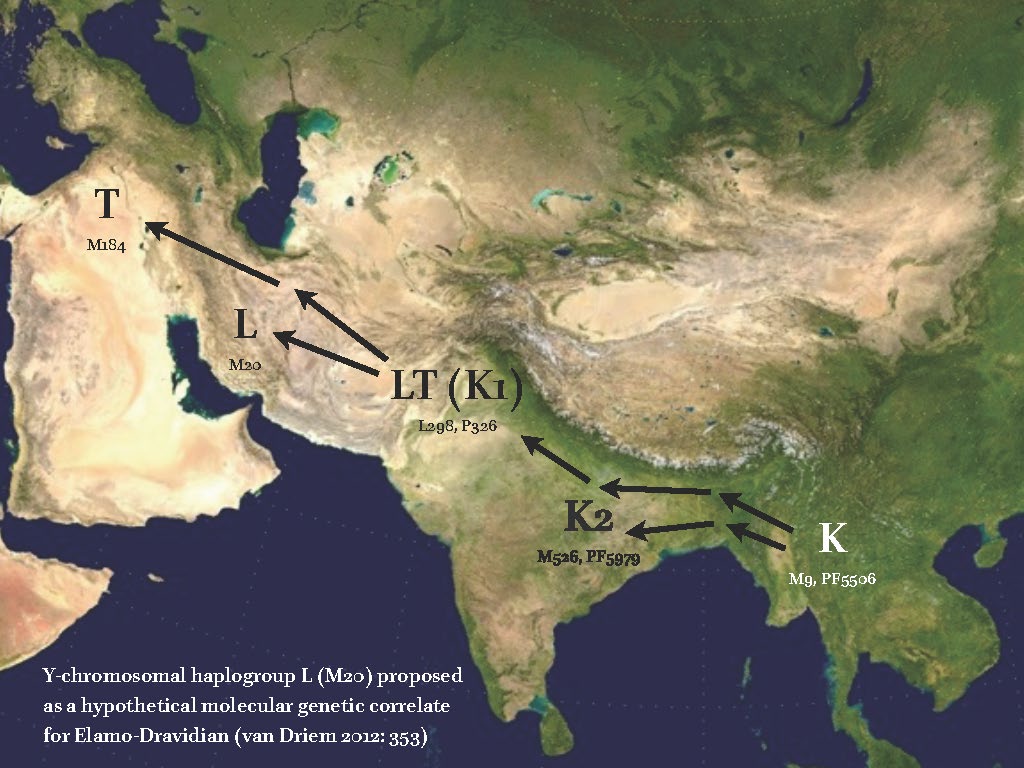
Although the Indus population may very well have been heterogeneous in terms of the paternal lineages present in the extensive area covered by this ancient civilisation, the hypothesis was advanced that the paternal lineage L (M20/PF5570) may be associated with Elamo-Dravidian civilisation (van Driem 2012: 353). Assuming the veracity of this hypothesis, this Y-chromosomal marker could serve as a molecular tracer dye for the waves of Indus migrants moving from the northwest into southern India at the beginning of the second millennium BC (Figure 1). Such correlations have indeed been observed in the Y-chromosomal phylogeography of the Indian subcontinent (Sequeira et al. 2023). It must be kept in mind that the chronology of the branching off of the various paternal subclades of the molecular polymorphism putatively associated with ancient speakers of a lost ancestral Father Tongue L need not necessarily have lain at the same time depth as the geographical dispersal of the ancient Elamo-Dravidian bearers of the haplogroups in question. This emerging Y-chromosomal picture appears to capture portions of the prehistoric dispersal of Dravidian, which Andronov (1978) visualised as originating in the northwest somewhere beyond the Indus and spreading gradually across the entire Indian Subcontinent toward the Palk Strait like 'a head of cabbage which shed its leaves one after another as it moved southwards.'
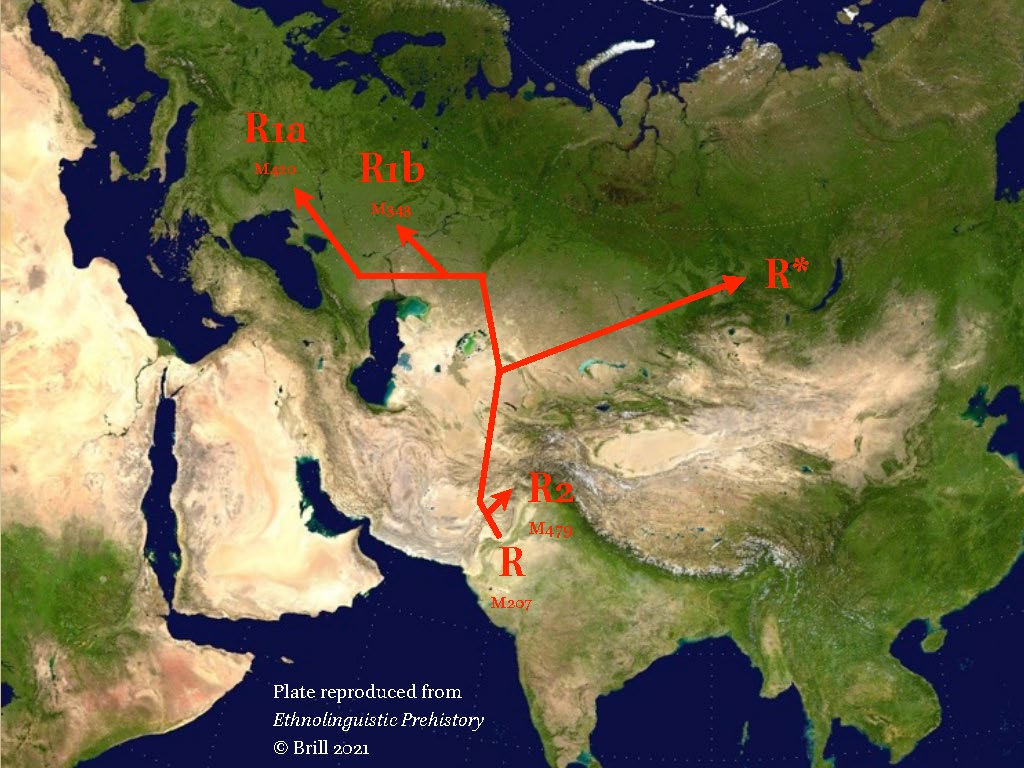
Frederik Kortlandt (2020) presented a comprehensive phylogeny of the Indo-European language family based on sound laws and innovations to the morphological system. In the updated Stammbaum, depicted by Raṇdhīr Śāṇḍilya in my ethnolinguistic handbook (van Driem 2021: 37), the bifurcation of East Satǝm into Indo-Iranian and Balti-Slavic is seen to constitute the most recent split in the chronology of branching of the Indo-European language family tree. Linguistic phylogeny therefore snugly fits the conventional view of a relatively recent Indo-Iranian linguistic intrusion spreading from Central Asia southward onto the Iranian plateau and into the Indian subcontinent in the early second millennium BC. The spread of the Y-chromosomal subclades R1a (M420) and R1b (M343) are currently considered to be the molecular proxies for the paternally mediated spread of Indo-European language into Europe as well as for the spread of Indo-Iranian from Central Asia into the Indian subcontinent at the time of the demise of the Indus civilisation. However, the spread of paternal lineages R1a (M343) and R1b (M420) into the Indian subcontinent from the northwest at this time form part of a larger episode of prehistory at a more profound time depth.
Inside India a controversy has long waged amongst scholars and laymen, with one camp knowledgeable with regard to the overwhelming cumulative linguistic, archaeological and, most recently, molecular genetic evidence for an Indo-Iranian linguistic intrusion into the subcontinent from the northwest and the other camp opposing an 'Aryan invasion' and favouring an indigenous origin for the Aryans, with a handful of Western polemicists egging them on. Witzel (1999, 2001, 2005) has occasionally taken the trouble to assail the indigenist stance, and popular scientific books have sought to enlighten the general public by undertaking to explain the more well-informed view of the peopling and prehistory of the Subcontinent (Joseph 2018, Thapar 2019). On the other side, a passionate belief in an indigenous Indian origin of the Aryans has spawned a veritable cottage industry of poorly informed popular polemic, brimming with misappraisals of the scientific evidence, e.g. Fraudley (1994), Knapp (2012), Lal (2015), Chavda (2017), Elst (2018), Talageri (2019), Sastry (2020). The latter group has failed to understand and consequently misinterprets the evidence and the science. But ironically these same polemicists might be pleased by the newer linguistic and Y-chromosomal evidence suggesting that that the linguistic ancestors of the Indo-Europeans, millennia before the advent of the Aryans to the Subcontinent, are likely to have been indigenous to India at some more distant point of time in the prehistoric past.
This evidence comes both from linguistics and population genetics. Ilija Čašule (1998, 2003, 2012, 2014, 2016, 2017, 2018, 2020) has adduced evidence for a deep genetic relationship between Indo-European and Burushaski. In their reactions to Čašule's 2012 presentation of correspondences in the Journal of Indo-European Studies, the late Indo-European linguist Eric Pratt Hamp and Phrygian scholar Vladimir Petrovič Neroznak favourably appraised the evidence (Čašule 2012).2 Čašule's linguistic hypothesis gains interest when viewed in the light of Y-chromosomal phylogeography. The finding that Y-chromosomal haplogroup R2 (M479) is the most frequently occurring paternal lineage amongst the Burusho dovetails neatly with Čašule's theory of a linguistic relationship between Burushaski and Indo-European. Assuming the applicability of the widely observed Father Tongue correlation, the phylogeography of the Y-chromosomal haplogroup R (M207) and its subclades suggests that a genealogical tie between Burushaski and Indo-European would have lain at the time depth of the clade R (M207) itself (Figure 2).
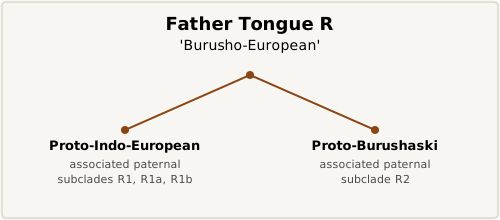
This Father Tongue R theory of a 'Burusho-European' proto-language, presented in the ethnolinguistic handbook (van Driem 2021), distils a whittled down version from Čašule's theory, with Proto-Indo-European associated with the paternal subclades R1, R1a, R1b and Proto-Burushaski associated with the Y-chromosomal subclade R2. At the time depth of the break-up of Indo-European, the Indo-Europeans spread from the Pontic Caspian steppe, bearing both their languages and their Y-chromosomal subclades westward across the continent of Europe, eastward into what today is East Turkestan and southward through Central Asia into the Indian subcontinent and onto the Iranian plateau. The East Satǝm branch splitting into Indo-Iranian and Balto-Slavic representing the most recent major split in the Indo-European language family tree, and the subsequent advent of the Aryans to the northwestern portion of the subcontinent coincided with the demise of the Indus civilisation in the early second millennium BC.
In fact, a causal relationship between the two has long been argued, with the Aryans depicted as illiterate bellicose migrants, exhilarated by the ephedra alkaloids contained in soma, overwhelming and infiltrating the urbanised and more urbane Indus valley civilisation. The Aryan linguistic intrusion into the subcontinent as depicted in the R̥gveda 'constantly assumes the form of an onslaught upon the walled cities of the aborigines,' i.e. the pur, with the Aryan god Indra featuring as the puraṃdara 'destroyer of aboriginal forts,' who shattered ninety of such strongholds (Wheeler 1966, 1968).
Gordon Childe (1964: 188) observed that the ancient Aryan bards 'sang their Vedic hymns in a prehistoric night, for the invasion completely broke the literary tradition, and there is no fixed point in Indian history till the reign of Darius.' Over a millennium later, ca. 500 BC, the bureaucracy of the Persian Empire brought the Aramaic variant of the Semitic consonantal alphabet to the Indus Valley, where this writing system was adapted, developing into the Kharoṣṭhī script.
So, whilst the Aryans do indeed appear to have come to India from the steppe, the ancestors of the Indo-Europeans, several millennia before the ethnogenesis of the Aryans, originated from India. Journalists have begun to share this message with the public at large, albeit in a simplified form (Asthānā 2023).
The Long Lost Ancestral Father Tongue P
Ilija Čašule's Burushaski theory therefore takes us back to a time long before the back migration of the ancient Indo-Iranians to the Indian subcontinent, further back to a more distant time when the linguistic ancestors of the Proto-Indo-Europeans first left the Indian subcontinent for the steppe, whence they would later disseminate in all directions, including back to the Indian subcontinent. In addition to arguing for the Indo-European affinity of Burushaski, Čašule's theory comprises two other subsidiary 'Burushaski-Phrygian' hypotheses, viz. a close genetic affinity between Burushaski and Phrygian and a provenance of the linguistic ancestors of the Burushaski in Asia Minor or even the Balkan. If, for the time being, we disregard the latter two hypotheses, for which the evidence to date appears to me to be less compelling, then we are left with the Father Tongue R, which we may call 'Burusho-European'.
An older linguistic theory with regard to the genealogical affinity of Burushaski takes us back to an even greater time depth in the prehistoric past. Morphological correspondences between the Burushaski and Yenisseian systems of biactantial verbal agreement were first adduced by Vladimir Nikolaevič Toporov (1969, 1971) as evidence of a genetic relationship. I proposed that Yenisseian could be related to Kusunda (van Driem 2001, 2008), with additional data on the Kusunda language made available by the late David Watters (2006). More recently, the Na-Dene languages have been added to this putative linguistic phylum (Vajda 2010, 2013), much of whose work owes an unacknowledged debt to the extensive research of the late Sergei̯ Anatol'evič Starostin. A critical appraisal of the various versions of this Greater Yenisseian or Dene-Kusunda theory was provided by Gerber (2017), who highlighted problematic and undecided issues.
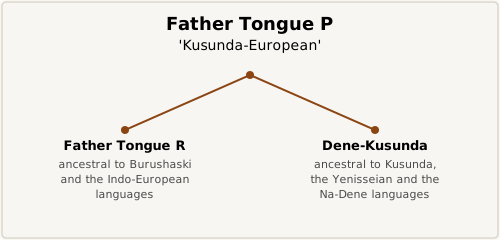
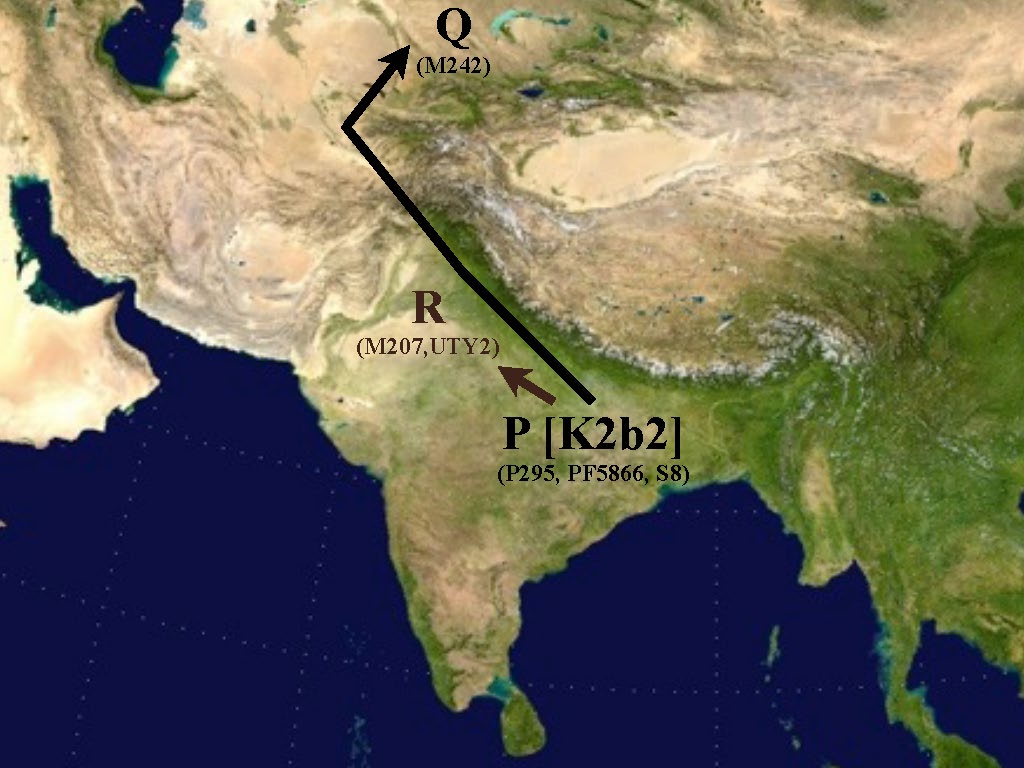
Fifteen years ago, in a Festschrift for the late Roland Bielmeier, I proposed that the dispersal of a subset of paternal lineages of the Y-chromosomal haplogroup Q (M242) might serve as a molecular tracer dye for the dispersal of the Greater Yenisseian or Dene-Kusunda linguistic phylum (van Driem 2008: 50). Both the paternal lineages Q (M242) and R (M207/UTY2) are subclades of the Y-chromosomal haplogroup K2b2 (P295, PF5866, S8), better known by its older Y Chromosome Consortium label as haplogroup P (Figure 3). The time depth of a hypothetical Father Tongue P most likely lies beyond the epistemological boundary of the Linguistic Event Horizon, but the highly flectional nature of this hypothetical 'Kusunda-European' proto-language can perhaps to some extent be inferred from the linguistic typology of its putative descendants.
Notes
1 This paper has been written up in sequel to a series of invited lectures which I have presented over the past few months, viz. 'The discovery of Indo-European: The true story' and 'The provenance of the coastal Karnataka languages and the Greater Dravidian question', both at Mangalore University on 19 December 2022, 'The Elamo-Dravidian linguistic theory and a hypothetical molecular genetic correlate', at Banaras Hindu University on 12 March 2023, 'Indo-European, Indo-Iranian and Burushaski: Linguistic intrusions and the Aryan controversy', at Mohanlāl Sukhāḍiyā University in Udaipur on 15 March 2023, and 'The Aryan Invasion controversy resolved: The lost ancestral Father Tongues L, R and P', at Banaras Hindu University on 24 March 2023. ↩
2 In addition to arguing for the Indo-European affinity of Burushaski, Čašule's 'Burushaski-Phrygian' theory comprises two other subsidiary hypotheses, viz. a close genetic affinity between Burushaski and Phrygian and a provenance of the linguistic ancestors of the Burushaski in Asia Minor or even the Balkan. Here I disregard the latter two hypotheses for which the evidence to date appears to me to be less compelling. ↩