In Memoriam
In Memory of Victor Golla (1939–2021)
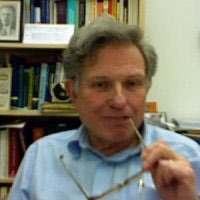
Victor Golla (1939–2021) was widely acknowledged as a leading authority on Native American languages, in particular those currently or formerly spoken in California and Oregon, including languages of the Athabaskan family. He earned his PhD degree at UC Berkeley in 1970 under the supervision of the distinguished Mary R. Haas. Golla wrote numerous journal articles and book chapters, authored a practical grammar (1986) and dictionary (2nd ed. 1996) of Hupa, as well as the book California Indian Languages (2011), and edited or co-edited Northern California Texts (1978). He also made an important historical contribution with his (1984) book The Sapir-Kroeber Correspondence. Letters between Edward Sapir and A. L. Kroeber, 1905-1925.
It may seem peculiar to some MT readers that we are eulogizing Golla, whom some have seen as an opponent of long-range historical linguistics, and specifically of Joseph H. Greenberg's Amerind hypothesis and book Language in the Americas (LIA: 1987). Golla's first review of LIA (1987) was quite positive, but his second review (1988) was much more negative.12
One important motivation for this memorial is the role Golla played in the development of my thinking about the "Sino-Dene" hypothesis, originally proposed by Edward Sapir in 1920. As reported by Golla (1984: 350), Sapir wrote to Kroeber "Do not think me an ass if I am seriously entertaining the idea of an old Indo-Chinese offshoot into N.W. America." Sapir, however, never published any grammatical or lexical evidence for this hypothesis. Another scholar, Sino-Tibetanist Robert Shafer (1952, 1957, 1969) did later publish several articles linking Athabaskan and Sino-Tibetan.
ACT I: Being curious about these circumstances, I decided to investigate the reasons why Sapir did not publish the evidence. Kaye (1992: 280) tried to claim that Sapir had been "led astray" into Sino-Dene because he did not know how to deal with the probability of accidental resemblances. Krauss (1973: 963–964) likewise considered Sino-Dene (as well as other hypotheses for the remote relations of Na-Dene) "purely speculative," and claimed that "Sapir was in fact clearly carried far beyond any objectively justifiable conclusions by his enthusiasm for the idea." These and other claims are rebutted in great detail in my 1994 article (pp. 210–214). Nevertheless, Kaye was probably right about the supposition that Sapir's mentor, Franz Boas, "who did not even accept Na-Dene, would have been 'angered and shocked' to see Sino-Dene in print." The conclusions from this investigation of mine were published in my 1994 article in Anthropological Science, in which I quoted Golla's opinion (1991: 138) that "the [Sino-Dene] connection is ... a plausible one, both on linguistic and anthropological grounds."
ACT II: George Starostin and I attended the Athabaskan Languages Conference at UC Berkeley in 2009. Both of us presented papers in which we expressed our common agreement that "Dene-Yeniseian" was not a taxonomically valid family or sub-family, because the Yeniseian family is more closely related to the small Burushic family (Hunza, Nager, Yasin dialects) and Na-Dene is more closely related to the large Sino-Tibetan (or Tibeto-Burman) family, than either component of "Dene-Yeniseian" is to the other. Thus, in our taxonomy the components are as follows (Bengtson & Starostin 2015: 5):
A. ʽSino-Deneʼ or ʽEastern Dene-Sino-Caucasianʼ
A.1. Sino-Tibetan (= Tibeto-Burman)
A.2. Na-Dene (Tlingit-Eyak-Athabaskan)13
B. ʽWestern Dene-Sino-Caucasianʼ
B.1. Yeniseian + Burushaski (Burusho-Yeniseian)
B.2. North Caucasian + Basque (Euskaro-Caucasian or Vasco-Caucasian)
My presentation was in the form of a PowerPoint, "Dene-Yeniseian" and "Dene-Caucasian," currently available at Academia.edu. Again, it cited Golla's opinion that "the [Sino-Dene] connection is ... a plausible one, both on linguistic and anthropological grounds." Golla was in the audience for my presentation (July 11, 2009).
ACT III: My presentation and its discussion time were followed by dinner. When I sat down I was pleasantly surprised that Victor Golla sat with me. His manner was very cordial, and he began with a narrative about the Pueblo Revolt of 1680. This was the only successful Native uprising against a colonizing power in North America. It kept the Spanish out of New Mexico for 12 years and established a different power dynamic upon their return. Victor stressed that the Athabaskan languages, and specifically the Apachean languages, are remarkably resistant to borrowing from European and other surrounding languages. This was so even though, in the case of the Pueblo Revolt, there was significant genetic admixture between Apachean and Amerind groups when the Pueblo populations took refuge with neighboring tribes.
Historic records document that during the formation of the historic Navajo population, large numbers of Pueblo refugees were absorbed into Navajo populations during the Pueblo Revolt of the 1680s ... the significant difference in haplogroup frequencies between the Apache and Navajo is the result of a large amount of admixture with different Southwest groups. Specifically, the Apache admixed with Yuman and Piman groups, while the Navajo admixed with Pueblo groups (Malhi, et al. 2003).
Finally, Victor broached the topic of the plausibility of Sino-Dene, and his opinion which I had quoted several times over the past two decades. Victor reiterated that he intuitively felt that Sino-Dene was probably correct but that it may not be 'provable' by traditional historical linguistic methods. So there remains a gulf between linguists who seek absolute 'proof' of a hypothesis, and myself and others who favor a 'best explanation' approach as more compatible with general scientific methodology (Bengtson 2008; Fleming 1994; Ruhlen 1994; Greenberg 1995; Vajda 1999; Newman 2000; Fleming 2008a; etc.).
Nevertheless, it was a pleasure and highlight of the conference for me to have this cordial conversation and settlement, of sorts, with Victor Golla.
12 "Victor Golla, after first endorsing the accuracy and usefulness of Greenberg's book, changed his mind a year later, for reasons unknown. In a thoroughly negative review Golla concluded that '[v]ery little of this [Greenberg's classification] will be taken seriously by most scholars in the field …primarily because Greenberg's proposed etymologies do not observe regular phonological correspondences" (Ruhlen 1994: 115). ↩
13 For some, like Jürgen Pinnow and Dell Hymes, also including Haida. ↩
References
14 My 1994 article is accessible on ResearchGate and Academia.edu. Thanks to Kenichi Aoki and the late Merritt Ruhlen for their help in preparing the article. ↩